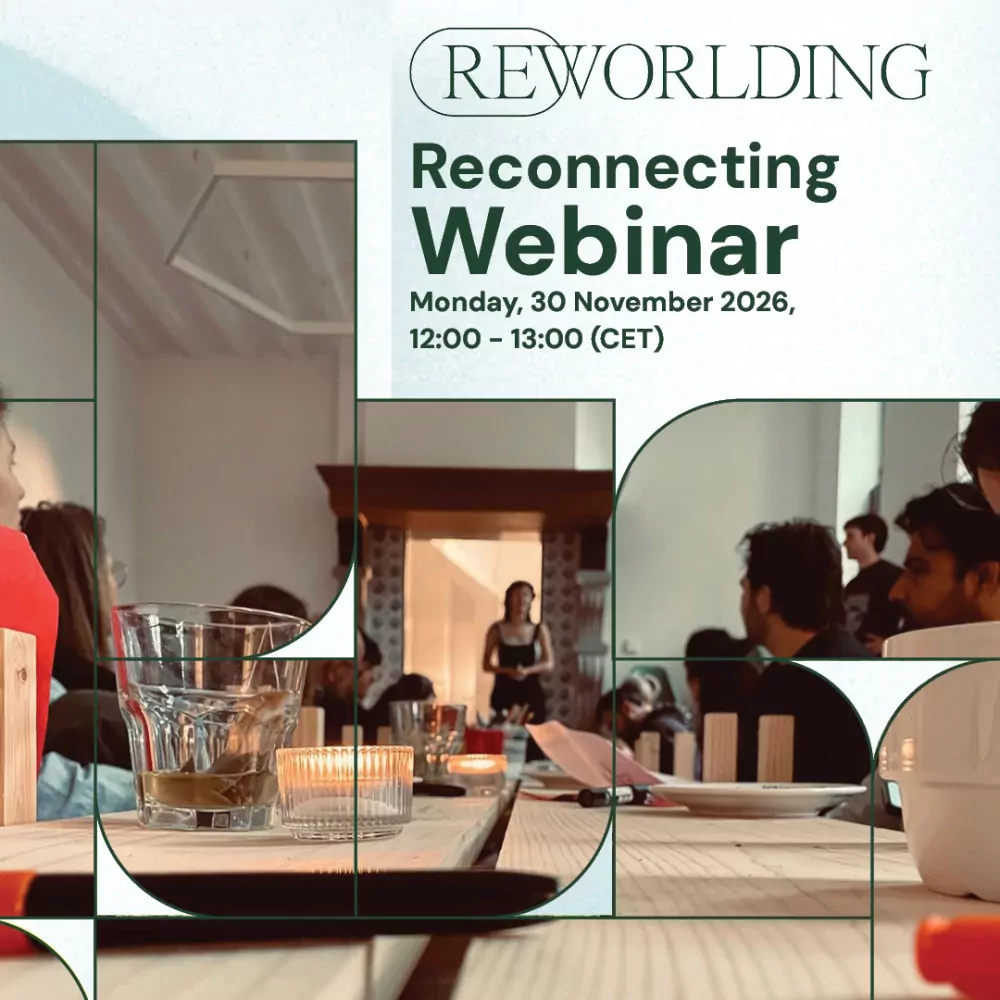
Reconnecting Webinar - Reworlding
Description
Date and time: Monday, 30 November 2026, 12:00–13:00 CET
Location: Online
How do we build connections across fragmented social and ecological worlds without pushing everyone to speak the same language?
In the REWORLDING project, we’ve been testing what reconnecting looks like in the field. Along the way, it has grown from a concept about bridging different sectors into a grounded, everyday practice: one that involves reconnecting across a pluriverse of human communities, with the more-than-human beings we share this world with, and with ourselves as researchers that are entangled with everything else. Reconnecting, both as researchers and in our everyday lives, depends on capabilities we can learn and nurture together.
In this one-hour webinar, we’re bringing together theory and lived experience from our fieldwork to introduce the Reconnecting Capabilities Fieldkit. Put together by our PhD cohort, the Fieldkit is a deck of cards and handbook filled with prompts, stories, and exercises for anyone curious about working in more situated, relational, and care-full ways. Join us to hear how these capabilities play out in our research contexts and to discuss how we can better listen, translate, and care for the worlds we share.
Speakers
Anna Seravalli is an Associate Professor of Design at Malmö University. Grounded in Participatory Design, her research explores the politics of collective action and the possibilities for democratic eco-social change. She builds long-term collaborations with fellow researchers and diverse societal actors, including citizens, public organisations, and civil society groups. By weaving together different ways of knowing and forms of action, these collaborations deepen our understanding of social change and strengthen our collective capacity to bring it about.
Li Jönsson is an Associate Professor at the School of Arts and Communication, Malmö University, Sweden. Her research sits at the intersection of design, science and technology studies (STS), and feminist technoscience. Through participatory, speculative, and artistic research practices, she explores how design can open up alternative ways of imagining and engaging with socio-ecological futures. Her work investigates how design can contribute to new forms of public engagement, reconfiguring relationships between humans, more-than-human worlds, and forms of collective life. She currently co-leads the artistic research environment Design after Progress: Reimagining Design Histories and Futures.
Melike N. Kaplan is an economic sociologist and design researcher based in Copenhagen, and a PhD Fellow in the Responsible Technology Futures (Re-TECH) research group at Aalborg University. Drawing on systems thinking, her research maps the Danish cooperative ecosystem and explores how participatory design interventions can help cooperative enterprises emerge and thrive. Grounded in feminist and creative methodologies, her work brings diverse actors together around shared eco-social goals, asking how we might move from economies of competition and extraction towards ones built on care and cooperation.
Petra Žišt is a cultural anthropologist and doctoral researcher at the University of Limerick’s Interaction Design Centre, working within the REWORLDING project. Her research explores how people experience and shape energy transitions in their everyday lives, particularly in social housing and community initiatives. Bringing anthropology into dialogue with participatory design, she examines relationships between people, technologies, and places, with an interest in how diverse experiences and local knowledge can inform more inclusive approaches to social and environmental change.
Xin (Xinquan Wen) (they/them) is a design researcher and somatic bodyworker, originally from Shanghai and currently based in Malmö. They explore how somatic practices can help people feel a deeper sense of belonging within their urban environment by attending to their surroundings. Motivated by climate urgency and Malmö as a site of superdiversity, they investigate how participatory design can invite broader engagement and amplify voices that are not always heard in climate conversations.
Programme
-
Reconnecting Capabilities in Practice (30 minutes): An exploration of overarching theories and an introduction to the Reconnecting Capabilities Fieldkit. Three PhD fellows will share insights on specific capabilities, demonstrate how they connect to their research practice, and engage in brief discussions with the other speakers at the end of each segment.
-
Panel Discussion (15–20 minutes): A discussion exploring the core themes of reconnecting and their practical applications.
-
Open Floor Q&A (10 minutes): An opportunity for attendees to ask questions and share reflections with the panel.
Register here: https://forms.gle/ux6to4ZehCDZYwMW9
For any questions, please contact info@reworlding.eu
Links