My Green House Challenge
Described by Asli Kolbas (author of the practice), based on Energy Model-Maker and the Sims MediatorDescription
Context
My Green House Challenge builds on the approach of the Sims Mediator Challenge (also in the Atlas of Synergies) but shifts fully to a physical, hands-on format. While the original game used The Sims Free Play, My Green House Challenge replaces the digital platform with tangible pieces, allowing players to build their homes, dress their game characters, and shape their neighbourhoods physically. This hands-on approach makes energy transition concepts more concrete and encourages discussion in a playful and interactive way.
Both versions of the game share the same overarching goal: to contextualize energy transition, moving from fossil fuels towards renewable sources, and to explore how homes, families, and neighbourhoods evolve during this process. Players are encouraged to reflect on their role as active mediators, considering how individual and collective energy-related decisions affect future societies.
Description
Gameplay and Mechanics
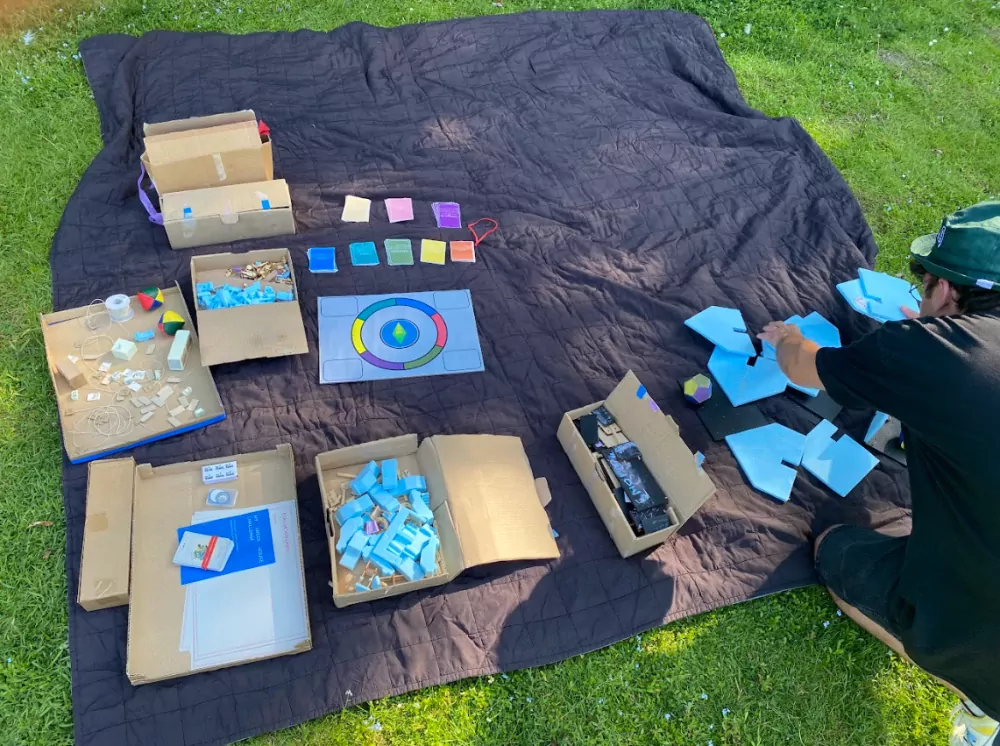
The game unfolds through short missions and story prompts that mirror real-life situations in the home and community. Players start with a "Build Starting House and Player" phase, receiving a floor panel, four walls, five coins, and a human piece to create their character. This phase integrates the physical house-building element from the outset, allowing players to engage directly in the construction of their home.
Players earn coins for completing prompt cards, which can be spent to upgrade their house by adding furniture, floor panels, walls, or energy transition tools such as solar panels, batteries, and heat pumps. Purchasing energy-efficient items may provide discounts or extra coins, emphasizing the economic and social benefits of renewable energy within the game mechanics.
Components and Card Types
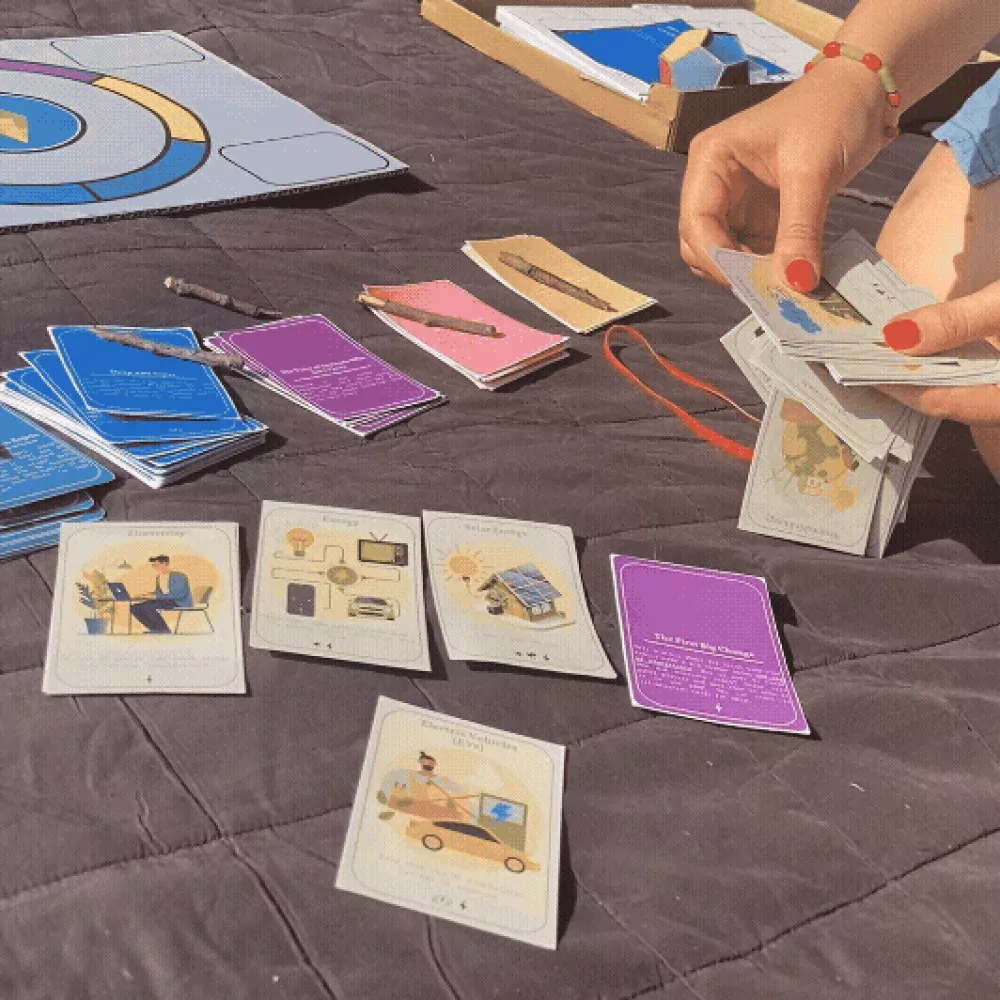
The game includes Illustration Cards, Prompt Play Cards, coins, and a puzzle system for tracking progress. New card types include:
- Ice Breaking Cards, designed to engage players and warm up discussions,
- Building Neighbourhood Cards, guiding collective construction of game scenarios.
Prompt Play Cards feature emojis representing energy transition concepts. When drawn, these cards are matched with corresponding Illustration Cards, providing a visual and conceptual learning experience. This enhances understanding of energy concepts more directly than the digital predecessor, which relied on Value Cards for governance, family, neighbourhood, and personal themes.
Progress Tracking and Rewards
Progress is tracked through a combination of the coin economy, tangible house improvements, and the puzzle system. This replaces the sticker booklet system from the original Sims Mediator Challenge, giving players clear, hands-on indicators of progress.
Roles and Facilitation
The roles of Game Master/Facilitator, Timekeeper, and Note Taker remain consistent with the original game, guiding discussions and documenting outcomes related to energy transition.
Next Steps
Future iterations will expand the game to cross-generational family groups and include policy-makers, broadening conversations about collective transitions and increasing the game's societal impact.
Engagement with more-than-human entities
My Green House Challenge engages with more-than-human entities in various direct and conceptual ways, primarily revolving around energy and technology within the context of a transitioning home and neighbourhood.
Natural Energy Sources
◦ The foundational concept of the game is moving away from fossil fuels towards clean, renewable sources like solar, wind, and geothermal energy. Players are invited to imagine a house that produces as much energy as it consumes, capturing sunlight and utilising generated power.
◦ The game illustrates how these systems are connected, such as solar panels generating electricity that is stored in batteries, excess electricity going to EVs or the grid, and smart home systems managing energy flow based on real-time demand and weather forecasts. This depicts a complex interplay of technologies.
◦ The concept of an "Energy Neighbourhood" extends this engagement beyond a single house to a network of homes sharing power, community batteries, shared EV charging stations, and local energy markets.
Interpretation as “retracing”
"Retracing" in this context refers to observing, documenting, and analysing the players’ journey, decisions, discussions, and learning outcomes as they progress through the game. The game’s design facilitates the generation of both quantitative and qualitative data that can offer rich insights into participants’ understanding, attitudes, and behaviours regarding energy transition.
Here’s how My Green House Challenge would be interpreted for data generation for research. For instance, we can track how many coins players earn (each prompt card played rewards a coin) and how they choose to spend them. Specifically, whether players prioritise basic house improvements (floor panels, walls, furniture) or invest in “energy transition items” like solar panels, heat pumps, and batteries. The discounts offered for buying energy transition items could reveal player motivation and financial decision-making within the game’s economy.
Is there a toolbox in development?
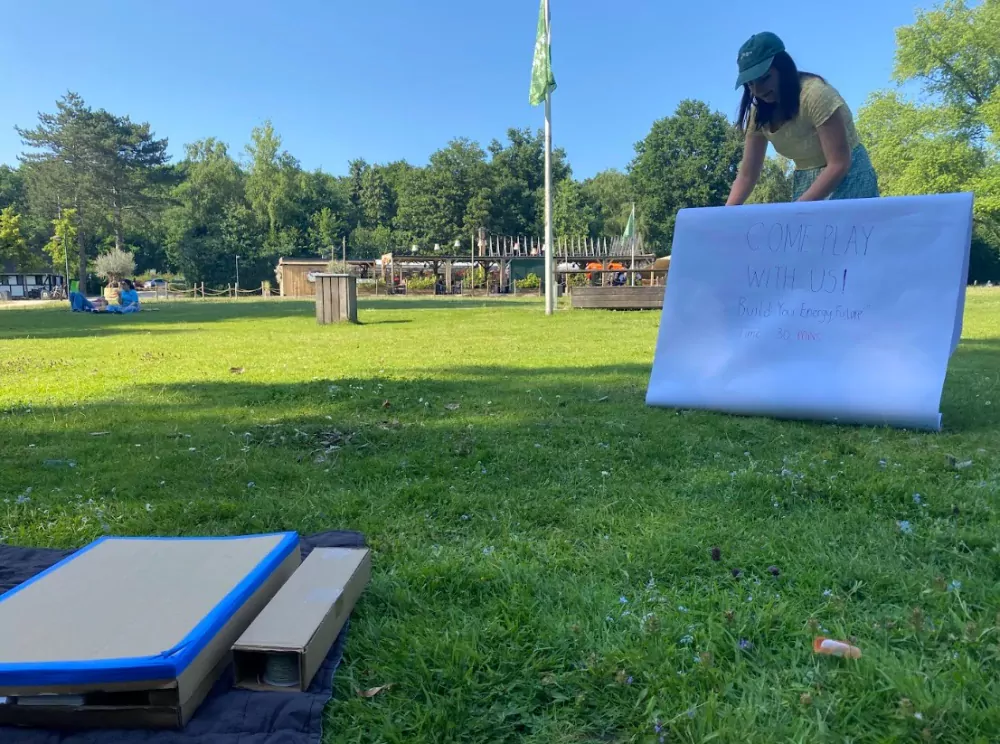
The prototype is still in the process of being tested. In the future, the toolbox for My Green House Challenge will be available online on the ReWorlding website and will include the core materials needed to run the game. An overview of the game components is already available.
Physical Game Components
-
- Starting house pieces: Floor panel and four outside walls for each player
-
- Building materials: Additional floor panels, walls, and furniture pieces for purchase
-
- Energy transition items: Solar panels, heat pumps, batteries (with discount mechanics built in)
-
- Human game pieces: For players to dress and customize as their character
-
- Coins: Physical currency system (starting allocation of 5 coins per player)
-
- Illustration Cards: Visual learning aids linked to energy transition concepts
Card System (8 color-coded types)
-
- Ice Breaking cards: For engagement and decompression at game start
-
- Building Neighborhood cards: Guide collective scenario construction
-
- Talk cards: Facilitate discussion
-
- Story cards: Narrative-driven prompts
-
- Twist cards: Introduce unexpected scenarios
-
- Energy shift cards: Focus on transition concepts
-
- Prompt Play Cards with emojis: Must be matched to corresponding Illustration Cards
-
- Total deck: Expandable system (evolved from 70 cards in Sims Mediator version)
Game Mechanics & Phases
-
Build Starting House and Player phase: Character creation and initial house construction
-
Prompt Play Cards phase: Earning coins through card completion
-
Economic system: Coin-based rewards with energy transition item discounts
-
Progress tracking: Puzzle system replacing sticker booklets
-
Cross-generational expansion: Designed for family and policy-maker inclusion
Facilitation Framework
-
- Game Master/Facilitator role: Guides discussions on energy transition
-
- Timekeeper role: Manages game flow
-
- Note Taker role: Documents outcomes and learning insights
-
- Multi-week engagement structure: Designed for sustained participation
Data Generation Tools
-
- Quantitative tracking: Coin earning and spending patterns
-
- Qualitative observation: Decision-making processes and discussion content
-
- Investment priority analysis: Basic improvements vs. energy transition items
-
- Learning outcome documentation: Concept understanding through emoji-illustration matching
Conceptual Extensions
-
- Energy Neighborhood framework: Community-scale energy sharing scenarios
-
- Smart energy hub prototyping: Tangible future home modeling
-
- Policy integration pathway: Structured inclusion of policy-maker perspectives
-
- Cross-generational dialogue protocols: Family engagement strategies
References
Transitionscapes. (n.d.). Prototype 2: Haven stad. Retrieved June 1, 2025, from https://transitionscapes.nl/projects/prototype-2-haven-stad/
Links