Cloudwalk
Described by Xinquan Wen (author of the practice)Description
Context
Cloudwalk explores how we can build deeper connections with our micro-climate in the context of the climate crisis. Cloudwalk, is an diffractive and immersive practice that explores the entanglements between clouds, wind, and landscapes through walking as a sensory and participatory method. Initiated in Malmö, this project follows the journey of a cloud from sea to city, investigating how urban environments shape atmospheric and hydrological flows. Scientific insights on cloud formations and movement patterns inform the practice, but rather than classifying clouds as fixed meteorological objects, Cloudwalk seeks to understand them as fluid, relational entities that connect human and more-than-human worlds. This project examines how participatory walking methodologies and inventive practices can foster care, collaboration, and collective learning.
Who: The current walkshop is designed for adults, yet it can be modified in order to become more kids friendly
When: Approximately three hours at afternoons (any time would work, yet more participants tend to be available during afternoons)
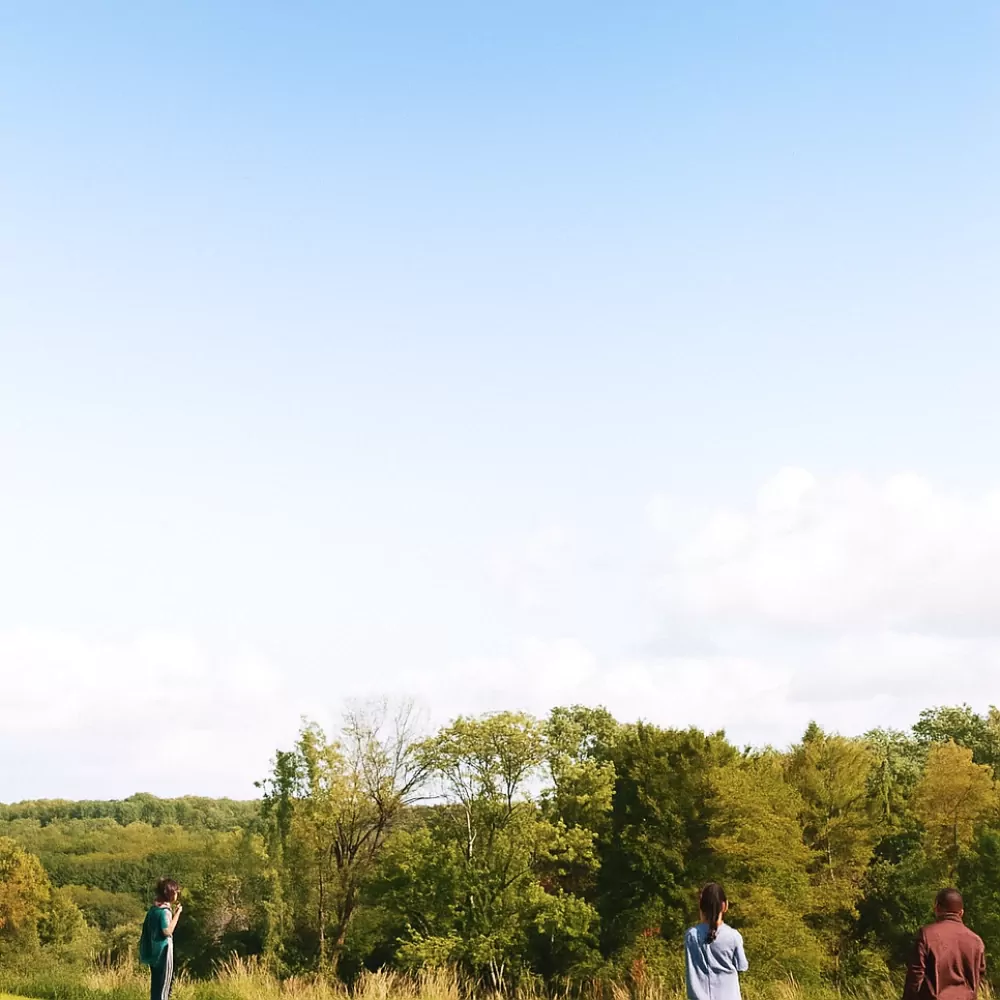
Where: The walkshop can happen as part of a hike, the location may vary. Ideally, the starting point should be an open field that allows for warm-up exercises and provides a clear view of the sky.
Description
Warm-up phase
To begin the walkshop, the participants are guided in tuning into the presence of clouds by connecting with their own breath. Through deep inhalations and exhalations, and by observing the edges of the clouds, they will try to experience their liveliness and subtle rhythms.
Next, they will explore the sensation of wind by amplifying its force using a plastic bag or a piece of light cloth. This embodied exercise invites us to imagine being carried by the wind - another way to relate to clouds, even if the wind at ground level differs from that in the sky. The moderator will also introduce the diversity of cloud types and their plural, shifting forms to set the stage for our exploration.
Forming Groups and Selecting a Collective Cloud
Together, participants will choose a cloud to observe. Though clouds are inherently plural and shifting, they begin by treating one as a singular entity. Standing in a loose formation, they will try to map the cloud’s shape from our positions on the ground - like a living diagram seen from above.
After this shared mapping, they will divide into groups . Each group will select a section of the cloudscape to follow, collectively deciding which part they are drawn to.
Following Clouds
Each group will begin a slow, intuitive walk to follow their chosen cloud fragment. The moderator will provide a set of guiding questions for inspiration, though groups are welcome to focus on their own lines of inquiry. Suggested guiding questions can be: What do your clouds resemble? How many colors can you see in your cloud? Do similar colors appear in your surroundings?
Recap and Reflection
The participants will regroup to share our experiences - our stories, observations, and any emotions or insights gathered through this encounter with clouds, sky, and the space around us.
Engagement with more-than-human entities
Clouds are driven by wind, formed by the evaporation and transpiration of water on the ground. The awareness of the intimate interconnectedness can lead to a soft kind of claiming (a phrase articulated by Matthias from MoB (Museums of Belgium), which means claiming the sky in an open manner, not as in occupying or owning it permanently, but more like recognising or rediscovering it), it is humble (I can only know the sky through my apparatus), inviting (leave room for others), and full of curiosity (the diversity and depth of sky offer unlimited possibilities to explore). These qualities (awareness, humble, inviting, full of curiosity) require time and space to germinate. Therefore, phasing and slowing down play important roles during cloudwalks.
Interpretation as “retracing”
Drawing on Karen Barad’s notion of diffraction, the Cloudwalks activity shows how data generation in Participatory Design (PD) can move beyond reflective or representational modes toward relational, situated, and entangled understandings. Rather than capturing singular, fixed “truths,” the recordings of participant conversations, gathered with consent, capture the ways in which meaning and matter emerge together through intra-actions within the environment.
For example, a participant’s description of the interplay of sunlight, clouds, trees, and wind was not merely observational but was shaped by the embodied, sensory, and more-than-human relations unfolding in the moment. Similarly, the challenge of locating clouds without fixed reference points prompted a reliance on relational language, revealing how participants collectively co-construct meaning in context.
By “retracing” these rich and diffractive dialogues during later analysis, researchers are not simply revisiting static data but are re-engaging with situated intra-actions that generated the experiences in the first place. This approach enriches PD data collection by:
-
- foregrounding environmental entanglements as part of the dataset;
-
- capturing co-created meanings in process rather than isolated participant outputs;
-
- and acknowledging that the context is constitutive, not incidental, to the data.
In contrast, a leaflet-based task I prepared for Cloudwalk asking participants to trace their path encouraged more representational responses, which risked diverting attention from the embodied present moment. This comparison underscores the methodological value of designing activities that maintain participants’ immersion in relational and dynamic contexts during data generation.
Case study
Dialogues from one cloudwalk exemplifies the usage of relational language when locating clouds:
🗨️ This one there. You know it's the big one and the small connection and you know, And underneath that it's...Again this one that has two parts. You understand which one I'm referring to. I think that somewhere there it's ours.
🗨️ So our clouds went up into a bigger cloud.
🗨️ Yeah. They connected.
🗨️ You lost it in a bigger one.
How relationality of outdoors inspired one dialogue on shadow during a cloudwalk
🗨️ If the cloud is in front of the sun like everything is in shadow because it's the shadow of the cloud and it blocks the light.
🗨️ yeah. And clouds themselves also have shadows ... the bottom... like that's dense or more packed..
🗨️ I think that in Greek there is this word like self-shadow.
🗨️ Yeah, self-shadow. Like dirty shadow, that's not like colourful or black shadow.
Is there a toolbox in development?
The researcher has been developing a small but growing toolbox of prompts designed to inspire embodied engagement with the sky and to foster deeper connection between participants and their surroundings.
This toolbox currently includes two main types of cards:
1. Action Cards - These offer simple, open-ended activities that invite participants to notice, move, and relate to the sky in new ways, often through defamiliarisation and playful embodiment. Some participants particularly enjoyed the cloud-breathing activity (photo attached). Others invented new variations during the walks - for example, following clouds while walking backwards. The aim is to gently shift perception and encourage a more sensory, relational engagement with the sky.
2. Quotation Cards - These are short, evocative excerpts from literature, philosophy, and poetry that act as “capsules” of thought, feeling, and imagination related to clouds. Their presence often sparks conversation; in some recordings, participants read the quotes aloud during their walk, weaving them into the flow of dialogue. Examples include:
“We find beauty not in the thing itself but in the patterns of shadows, the light and the darkness, that one thing against another creates.”
– Jun’ichirō Tanizaki, In Praise of Shadows
“Bring the pure wine of love and freedom.
But sir, a tornado is coming.
More wine, we’ll teach this storm
a thing or two about whirling.”
– Rumi, in Hush, Don’t Say Anything to God (trans. Shahram Shiva, 1999)
Together, these cards act as a flexible and evolving toolbox that supports Cloudwalk participants in slowing down, noticing, and engaging with their environment and each other in more attentive and imaginative ways. I consider it a living set of practices - continually enriched by participant contributions and responsive to the unique atmospheres of each walk.
This toolbox is still in prototype phase and will be launched online on the ReWorlding website soon.
References
Springgay, S., & Truman, S.E. (2017). Walking Methodologies in a More-than-human World: WalkingLab (1st ed.). Routledge. https://doi.org/10.4324/9781315231914
Amsterdam School for Cultural Analysis. (z.d.). Walking as Research Practice (WARP). https://asca.uva.nl/content/research-groups/warp/walking-as-research-practice.html
Cloud Appreciation Society. (z.d.). Cloud Appreciation Society. https://cloudappreciationsociety.org/
Christo & Jeanne-Claude. (1972). Valley Curtain, USA. https://christojeanneclaude.net/artworks/valley-curtain
Links
-converted.webp)
-converted.webp)