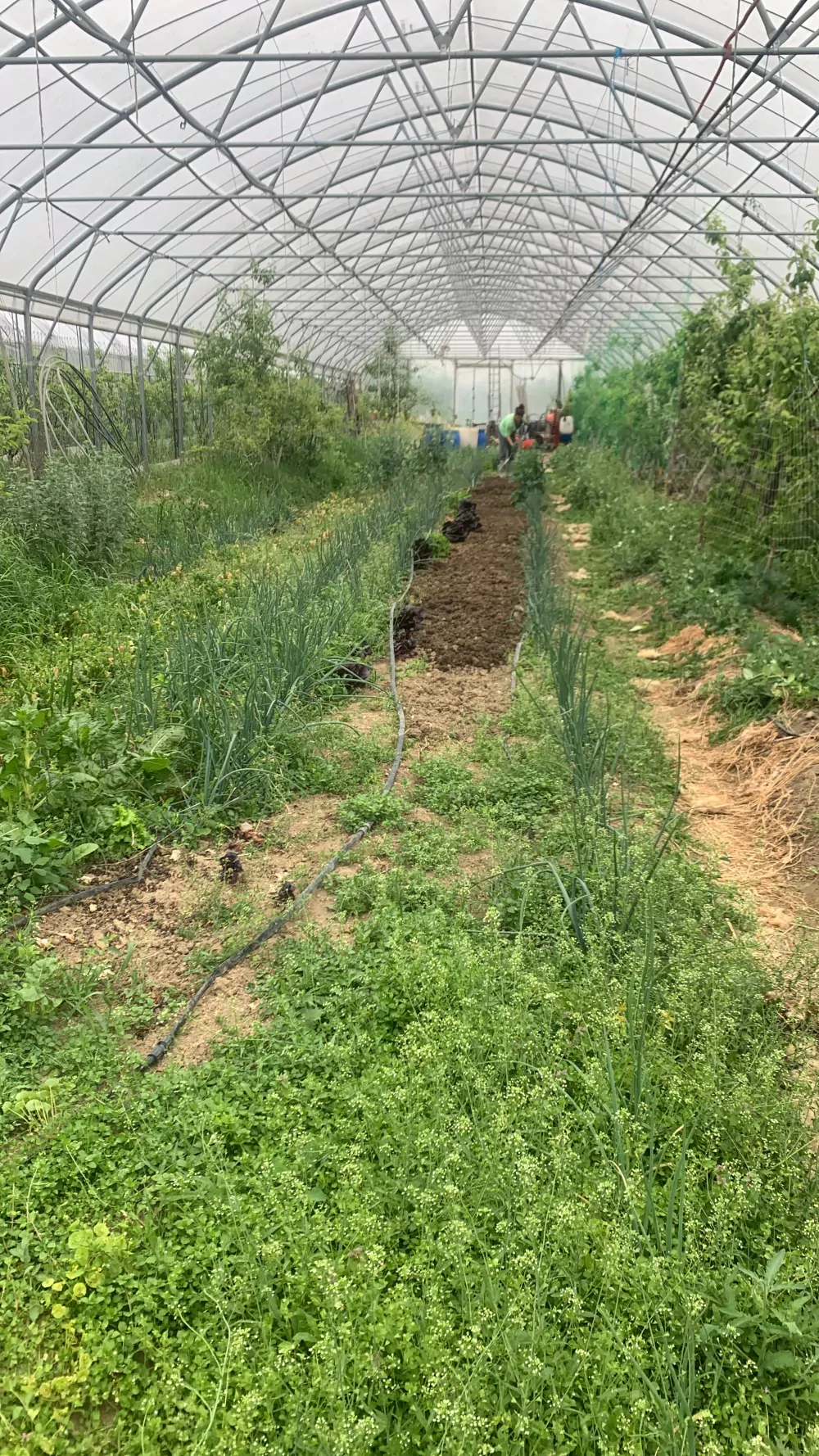
Volunteering in organic farm
Described by Júlia Tena Mensa, based on Flachs (2013)Description
Description
Volunteering and solidarity activities have been tools employed in ethnographies to gather information from an active position by the researcher. This positionality brings a new perspective on the context being studied, while also enhancing closer and trusted relationships with the participants.
As part of farm visits planned for research in the framework of ReWorlding, it was suggested by the producer to join the volunteer visit of a programme managed by an external association. In this farm, the volunteers help the producer on Mondays. After the first day, it was decided that the researcher would attend every week.
These regular volunteering days with the association provided the researcher with immersion in a context not accessible through interviews or farm visits alone. Being present and working allowed the researcher to share the ordinary moments of working on a farm.
These days would consist of the organisation and distribution of tasks over a coffee in one of the greenhouses, a morning of work on specific tasks, and having lunch together. By sharing with other people the space, the activity, and in some cases, the exhaustion, the researcher fostered informal relationships and conversations on personal stories or opinions on food, political, and social movements.
In this way, the farm visits combined participant observation together with volunteering, resulting in the creation of several days of fieldnotes and the development of awareness and understanding of farm work, its practices, and routines.
Engagement with more-than-human entities
Farming labour, and specifically on an organic farm, is an activity in which connection with the more-than-human is part of it. As part of organic farms, the production is based on the care of the plants more than their exploitation. In this way, the researcher learned to establish a relationship of respect between themselves, the human acquiring the fruit to be sold as a commodity, and an existing living being.
In this relationship of respect and care, the researcher developed an understanding of how to provide optimal conditions within the built environment of a farm. They also learned how to observe the whole living system on the farm and how all its elements are interconnected.
Interpretation as “retracing”
Other methods, such as focus groups or interviews, are able to tackle particular issues efficiently. Even though volunteering requires more time and resources, volunteering on the farm provided the researcher with the extensive opportunity to observe firsthand the range of issues that were covered in the interviews.
In this way, the researcher was able to develop a closer relationship with the farm and the producer by combining the two approaches. Re-tracing meant, hence, working by being there, doing the work by participating in an active manner to the farm work and to the volunteers work.
Case study
Volunteering work was part of the ReWorlding project, carried out in an association based in Karlovac. The Karlovac area is one of the poorest in the country, with almost 30% of the population in risk of poverty. Volunteers of the association assist local farmers in the production of food, which is then purchased at a reduced price. The association subsequently distributes the food to people in need, acting as an intermediary between producers and consumers.
References
Flachs, A. (2013). Gardening as ethnographic research: Volunteering as a means for community access. Journal of Ecological Anthropology, 16(1), 97–103.
Links