Broccoli Tree Challenge
Described by Júlia Tena Mensa (author)Description
Description
The Broccoli Tree Challenge is a participatory activity inspired by the widely used Problem Tree method. The Problem Tree is a common tool among researchers for identifying the causes, problems, and symptoms of specific social situations in collaboration with a group of participants. It helps to highlight key issues affecting a particular group, encourages discussion, and generates data in a democratic and horizontal manner.
This method has proven effective and is recognized by practitioners for its ability to identify problematic issues. Through the process, participants make sense - both individually and collectively - of their working lives and experiences. They identify their own challenges and adopt strategies to adapt to constant changes in the political and economic landscape.
In the ReWorlding case study on agroecological farms, consumers and wider civil society recognise the need to build new food systems. Systems that improve the country’s food sovereignty while ensuring access to healthy and sustainable food.
Nonetheless, there is limited knowledge about how to establish collective and individual practices that lead to better working conditions and a more environmentally and socially sustainable food system. This example highlights the importance of participatory design, and while the Problem Tree method is useful for initiating discussions among diverse actors, in this case, the priority was not to identify problems, but to focus on solutions. This is the foundation of the Broccoli Tree Challenge.
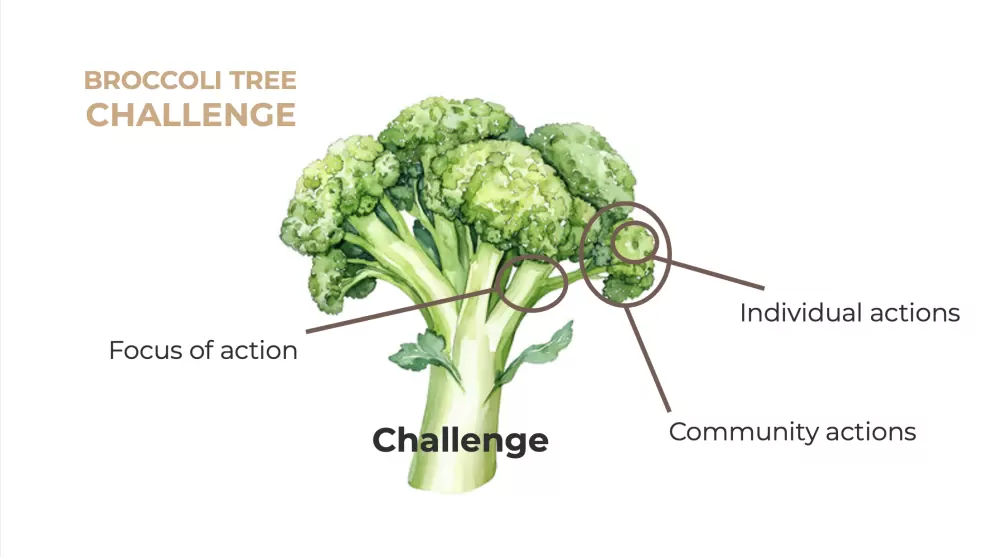
The Broccoli Tree Challenge begins with identifying a shared challenge, for example, building more sustainable local food systems. By inviting multiple stakeholders (producers, consumers, policy makers, etc) into the conversation, this method helps identify several action areas (represented as the “branches” of the broccoli), along with corresponding individual and collective actions. (example Broccoli tree)
In this way, the method fosters discussion around actionable steps. More importantly, it encourages thinking both as a community and as individuals, working toward a common goal.
Engagement/link with more-than-human entities
This method faces similar challenges to other human-centered participatory approaches, in that it leaves little space for the direct inclusion of more-than-human participants. Their involvement is often mediated through the human mind and imagination.
Nonetheless, their inclusion is both important and essential to the topic of this research. As mentioned earlier, sustainability in local food systems must take into account the full range of entities involved, from the compost worm to the final consumer.
Therefore, integrating more-than-human perspectives into this method could be supported by combining it with other artistic approaches. For example, counter-mapping more-than-human actors within the local food system could serve as a complementary tool to guide discussion during a Broccoli Tree Challenge applied to food systems.
Interpretation as “retracing”
Much like the Problem Tree method, the Broccoli Tree Challenge creates space for discussing the underlying issues within a given challenge. Through this process, the method enables a revision of the data, offering more nuanced understandings of the problems in relation to both the challenge and potential solutions. In this sense, it allows the problem to be retraced, approached from the other end. Moreover, it opens up opportunities for the inclusion and active listening of multiple voices and stakeholders, enriching the discussion through diverse perspectives.
Reference
Chambers, R. (2002). Participatory workshops : a sourcebook of 21 sets of ideas and activities (1st ed.). Earthscan Publications. https://doi.org/10.4324/
Links