Asparagus socialities
Described by Anna Tudos (Author of the practise)Description
Context
Asparagus socialities is an ethnographic research interwoven with arts-based methods in a prominent agricultural region, the Upper Adige valley in South Tyrol. It supports to understand entanglements around a certain crop, the asparagus.
Description
Eating is an entangled act. Through consuming plants, we are connected to not just processes of growing, caring for, or preserving plants, but also the ecological landscapes and the many more-than-human actors that the plants are in relation with. Through eating, humans acknowledge and act out the interconnectedness of life on Earth, however, this is increasingly difficult to notice. Our contemporary food systems and agricultural processes make sure that us, humans, have access to sufficient and varied ingredients and food to eat. However, with increasing globalisation, urbanisation and the automation of growing processes to support mass-scale growing particularly in the Western world, agriculture is not often regarded as a multispecies infrastructure.
Using arts-based methods and critical posthuman theory, this multispecies ethnography aims to foreground the actors entangled with asparagus and highlight certain needs and relations around the plants that have a shaping effect for landscapes, social dynamics and cultural patterns (Braidotti & Hlavajova, 2018). In this way, I don’t follow communicative or interactive acts and features of the plant, instead, I explore how ‘asparagus’ as we know it is constituted in relation with others, through reactions and transformations (Tsing, 2013). To draw out these relations, I explore the diverse biological form of the plant, what it documents and what is prescribes. For example, flavour is one aspect through which the asparagus acts. Another aspect is its form(s) beyond the form we know, for example the asparagus plant that grows into a bush and provides habitat for plenty insects. Through the socialities lens, we can also analyse the asparagus assemblages: where does the plant grow or who is it surrounding itself with. Place, in this instance is understood as a multiplicity of worlds, mediated and shaped by plants (Ogden et al., 2013). Through the assemblages, we can see connections to the landscape, especially the role of the river that carved the valley and how human activity transformed its former flood area after it has been regulated.
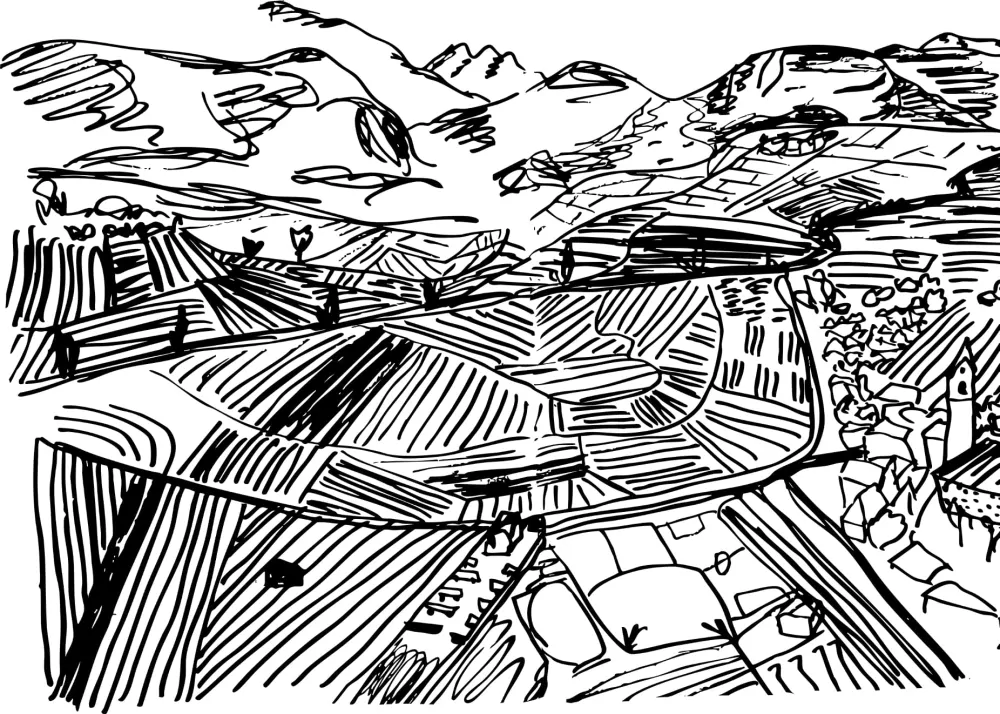
This multispecies ethnography aims to uncover dynamics through a close relationship with the landscape: field-based observations and place-based knowledge cultivation are two key strategies of the study (Tsing et al., 2024). This process involved walking the fields with people in close relationship with the plant, taking part in harvesting, processing work as well as other activities such as festivities or guided tours. Drawing from socially engaged art, and the anthropological practice of field drawings; I started by reimagining how drawing in this multispecies context could be used to connect place, experience and cultural data.
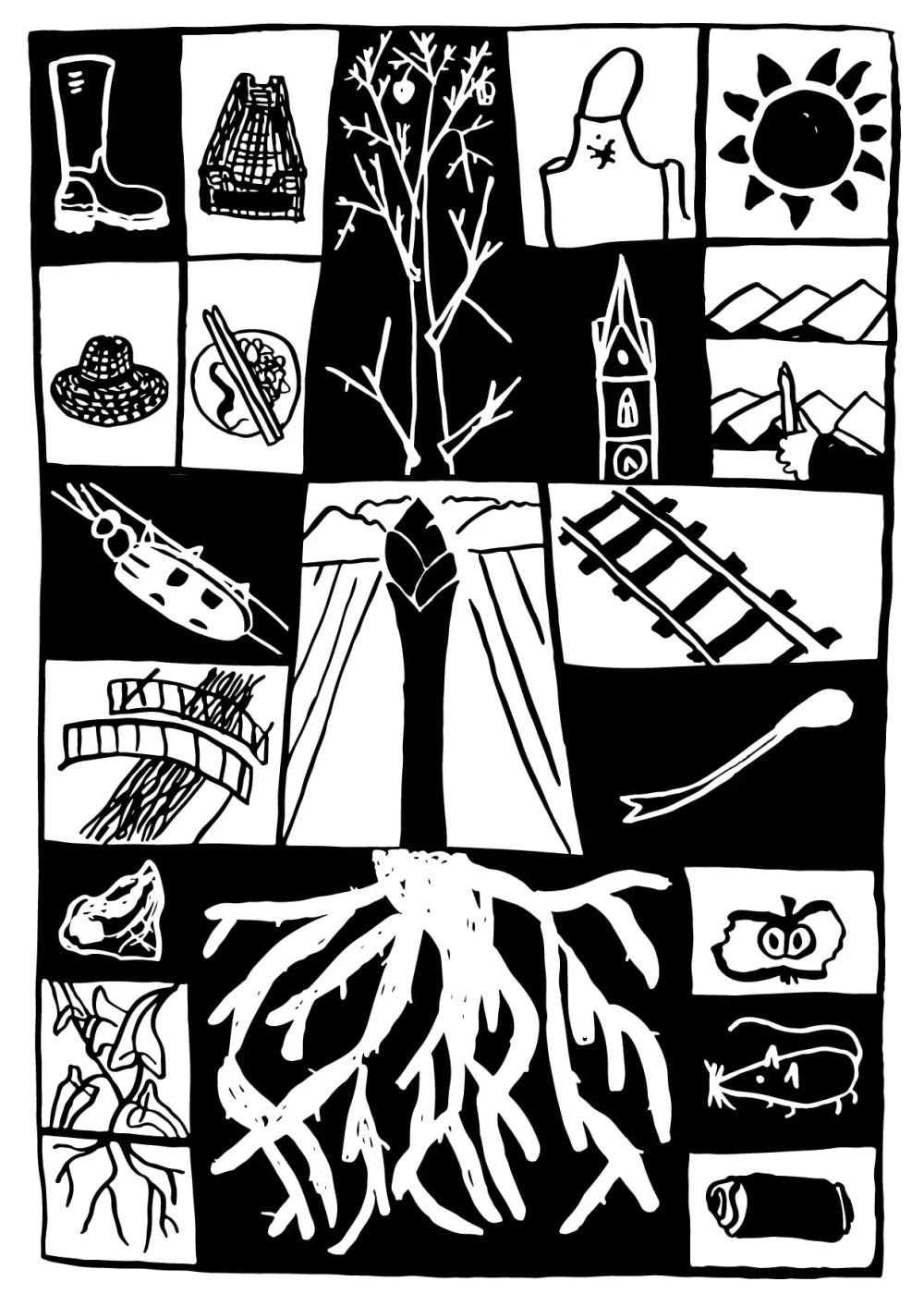
Drawing or sketching are common practices in ethnographic fieldwork that allow focused attention in contrast to instant photographs or video recordings (Azevedo & Ramos, 2016). The resulting ethnographic drawings are post-representational, meaning they don’t wish to capture the form of the plant or its environment perfectly, as it is visible to the eye. They are interpretive tools used to think through socialities. Drawing plants in this context revealed their interconnected nature instantly, as it was difficult to find where the drawing/the plant might end. For example, soil worlds are a crucial part of the ‘asparagus story’, however invisible to human eyes. Drawing revealed that the relations of the asparagus go beyond the close ‘plant community’.
The research goes deep into a local phenomenon, but the results are pointing at larger processes such as transforming landscapes, loss of nature connectedness, and the particularities of seasonal labour conditons. Following on from this, and applying critical post-human theory, the drawings became research tools to engage with two groups of human actors in the asparagus socialty, the farmers and the seasonal workers. Through sharing the drawings, discussing, and editing them together, important discussions were catalysed, blurring the dychotomies between the wild and domesticated, the green and white and the South Tyrolian and Romanian asparagus.
In conclusion, I understand plants, and specifically the asparagus as political and entangled in other challenges such as land use, fair labour conditions, cultural identity and technological innovation. Weaving together the embodied experiences from fieldwork and arts-based methods, I was able to see what the plant does, not just what we think it is.
Engagements with more-than-human entities
Re-tracing asparagus socialities is a multispecies ethnographic research, centring on a concrete more-than-human, the asparagus. Through mapping its socialities, it asks what the asparagus does in relation with other actors, human or more-than-human and how it shapes its environment and beyond. These socialities take us beyond the plant, connecting the micro with macro levels, and pointing out the interconnectedness of all life. Choosing an edible plant is also an active stance for pointing out how these entanglements are invisible to most consumers. Even when we interact with the plants in question closely through common rituals such as cooking and eating, we don’t see them as living actors with social power, in their other forms.
Interpretation as “retracing”
It is easy to point out that everything is entangled; however, describing exactly how these entanglements operate is a complex task. Mapping socialities offers a way to think through the asparagus’s interrelations and trace back how they are forming and reproducing certain practices. Drawing can also be a useful method to point out and describe invisible or rarely considered entanglements that reproduce social orders and hierarchies. In this work, drawing is used as a non-representational method and as a container of different types of information: geographic, cultural, and ecological.
Case study
Focusing on the domesticated asparagus’s biological form, the researcher quickly determined that the form of the asparagus is indeterminate. The shoots produced are white while underground, but green as they emerge and start photosynthetising. The flavour profile of the asparagus changes too and inscribes locality into the socialities: the shoots are best eaten fresh, consumed the same day as harvested. With time spent in transport, asparagus loses flavour gradually. Together with the rows of apple that surround the significantly smaller asparagus fields, these plants are growing in a landscape not quite urban and not quite rural, which can be described as the ‘semi-periphery’ or a ‘rurban’ place. They are busy, transitional places, closely tied to the urban areas. The plant’s routes make a dense web in these landscapes, that consumers rarely trace.
Considering edible plants only in their form that’s most useful to us is another pitfall of anthropocentric thinking. Asparagus farmers have to be careful to only take a certain amount of shoots, letting some others grow to let the plant survive for next year. This means in the summer the fields are populated by a bushy plant, that not many recognise, nevertheless it has its own relations with insects, water and other plants (weeds). The different forms of the asparagus repeat in a cyclical manner. The researcher got to experience these different forms, the meanings and relations they hold and the assemblages they enter through embodied field research and drawing.
Is there a tool (in development)?
Beyond a tool to focus my thinking and notice the field differently, I also used drawing as a tool to generate verbal data. I strategically shared my field drawings (complemented with notes) with human participants, or created them in company. I created cards with illustrations to help me imagine what it might be like to be an asparagus. I made paper with dried asparagus peel to ‘freeze’ the materiality of asparagus, spend even more time with it, and bring it into the picture in a quite literal sense. Human participants, farmers, workers and locals often reflected on the drawings, in some cases even asked to change them (which I encouraged). Having the drawings on my person was useful in some cases where language barriers prevented me from communicating something verbally. The drawings used in this way are continuously developing, opposed to traditional botanical drawings, they are fluid and ever-changing.
References
Azevedo, A., & Ramos, M. J. (2016). Drawing close–on visual engagements in fieldwork, drawing workshops and the anthropological imagination. Visual Ethnography, 5(1).
Braidotti, R., & Hlavajova, M. (Eds.). (2018). Posthuman glossary. Bloomsbury Publishing.
Ogden, L. A., Hall, B., & Tanita, K. (2013). Animals, plants, people, and things: A review of multispecies ethnography. Environment and society, 4(1), 5-24.
Tsing, A. (2013). More-than-human sociality: a call for critical description. In Anthropology and nature (pp. 27-42). Routledge.
Tsing, A. L., Deger, J., Saxena, A. K., & Zhou, F. (2024). Field guide to the patchy Anthropocene: The new nature. In Field Guide to the Patchy Anthropocene. Stanford University Press.
Links