Nomadic Landscapes
Described By Federico BigaranDescription
The perception of landscape in nomadic shepherds across common lands.
Context
Using semi-structured interviews and photographs two different nomadic shepherds groups were investigated (period 2007-2010) about their landscape perception: the shepherds of the Mongolian steppes and the shepherds of the alpine and sub-alpine areas. The first group constitute the majority of the Mongolian population and the local economy is almost entirely based on nomadic pastoralism, the second group are definitely a minority, residual elements of a once broader phenomenon, forced to move continuously within a social context that is deeply altered and increasingly hostile.
Description
Today, the movement of peoples and individuals is characterized by massive migrations, caused by wars, political and religious conflicts, climate change, and economic crises, but also by opportunities and individual choices that see mobility as a possibility for renewal and growth.
The ancient Greek word Νομάς (Nomas) means shepherd, the one who grazes roaming about for pasture, without a permanent home, but is also referred to the law, custom, or usage deriving from the root 'nemein,' which means 'to divide,' 'to share,' 'to graze.' From this also come words like 'nemesis' (administration of justice) and 'nomisma' (current coin) and, of course, “nomad”. The connection between nomadic shepherding and traditional laws is clear, especially regarding the use of common lands. Given the global threats and significant changes, including biodiversity loss, climate change, and escalating conflicts over resource use, it is worthwhile to consider alternative ways to tackle these issues. Approaches such as adaptation, mitigation, and resilience practiced by nomadic shepherds showcase how their unique knowledge and connection to the land can help develop a new ecological perspective that honours biodiversity, natural resources, and the living landscape.
The data and visuals gathered through interviews are viewed from five distinct perspectives on cultural landscape perception: as a setting, as a resource, as a creation and construction, as subject to damage and degradation, and in terms of its spiritual meaning. The complex system of relationships between spaces, times, and subjects is also explored within the discipline of ecology approaching phenomena from a non-anthropocentric viewpoint, aiming to achieve ecological balance by minimizing human impact and safeguarding ecosystems. The capacity to move or migrate, both horizontally and vertically, when conditions become unfavourable, has enabled the survival of humans and animals throughout the centuries. The use of common resources by even large herds requires shepherds to find the right balance between resource conservation and the need for sustenance.
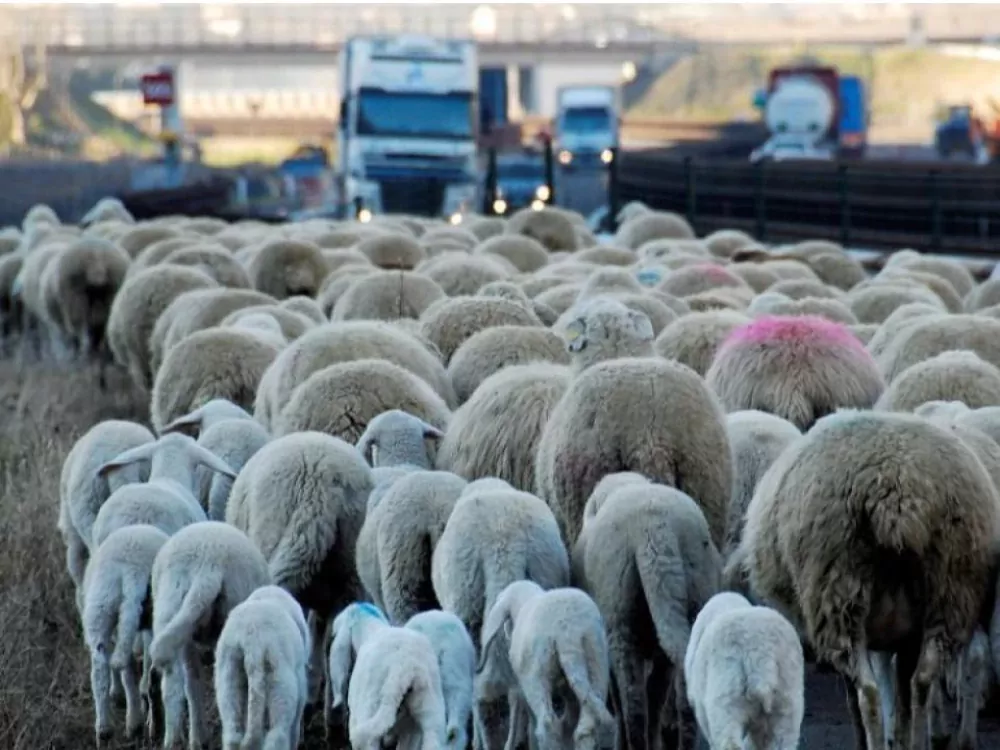
The shepherds seen from close.
Various initiatives are currently being implemented, including festivals, social events, exhibitions, and museum activities, to educate the general public about the lifestyle of transhumant shepherds. Participating in walks with the shepherds and their flocks, sharing meals, and observing how they navigate different circumstances on their journeys in search of pasture enables individuals to gain a deeper understanding of the nomadic existence of these shepherds. The inclusion of transhumance in the National Register of Rural Landscapes, Agricultural Practices, and Traditional Knowledge in 2017, followed by its listing on the UNESCO Representative List of the Intangible Cultural Heritage of Humanity in 2019 and the UN declaration of 2026 as International Year of Rangelands and Pastoralists, has further stimulated these initiatives.
Engagement with more-than-human entities
“Transhumance has an impact on the spatial heterogeneity of vegetation, affecting ecosystem processes and landscapes” (UNESCO, 2019).
This acknowledgment aligns with the increasing interest in how animals influence the landscape and takes advantage of the emphasis that more-than-human geographies place on human-animal interactions. Animals, along with the practices that guide their management, can be utilized in conserving and managing rural landscapes and agro-ecosystems. Both animals and shepherds actively participate in the conservation, upkeep, and restoration of the ecological systems they contribute to creating.
Interpretation as “retracing”
By observing transhumant shepherds in diverse settings, such as the Alps and Mongolia, and examining their perceptions of the landscape, we gain insight into the interconnections among mobility, land utilization, natural resources, and the environmental role played by grazing livestock. The skills and insights that shepherds have gained over thousands of years serve as a valuable resource for handling both emergency situations and the everyday care of pastures and livestock.
The landscape, as we understand it, has always emerged from the interaction between nature and humans. To preserve this balance and uphold the unique qualities of a landscape that offers hospitality and resources, it is essential to acknowledge the role and significance of extensive, nomadic, and transhumant pastoralism. This form of pastoralism helps maintain the functional aspects of the "living landscape," enhancing both its collective value and overall quality.
Case study
https://www.researchgate.net/publication/323167004_SHEPHERDS_IN_THE_ALPS_-_SHEPHERDS_IN_MONGOLIA
Is there a tool (in development)?
TRANSFARM is a European project (Erasmus+) that developed training material for transhumance practitioners available online and other documents on transhumance and its benefits. I wasn’t directly involved in the project.
References
VV.AA. (2007). Shepherds in the Alps; tales and true stories - Pastori nelle Alpi; storia e testimonianze. Giunti Progetti Educativi.
Bigaran, F., Brugnara, R., & Cristoforetti, C. (2011). Shepherds in Mongolia and Shepherds in the Alps. Poster presented at the International Symposium Pastoralism in Central Asia, Kyrgyzstan, 13–18 June 2011.
Bigaran, F., & Cristoforetti, C. (2012). The right to be nomadic – Il diritto di essere nomadi. Terra Trentina, 3.
Liechti, K., & Biber, J. P. (2016). Pastoralism in Europe: characteristics and challenges of highland-lowland transhumance. Rev Sci Tech, 35(2), 561–575. https://doi.org/10.20506/rst.35.2.2541
Bigaran, F., Brugnara, R., & Cristoforetti, C. (2017). La percezione del paesaggio in gruppi sociali nomadi e stanziali: tre casi di studio a confronto. Dendronatura, 2.
TRANSFARM. (n.d.). Project TRANSFARM – Vocational education & training for transhumance practitioners. https://transfarm-erasmus.eu/ (Accessed 27 October 2025)
Belliggiano A., Bindi L., Ievoli C., 2021, Walking along the Sheeptrack. Rural Tourism, Ecomuseums, and Bio-Cultural Heritage, Sustainability 2021, 13, available online: https://doi.org/10.3390/su13168870.
UNESCO. (n.d.). Transhumance: the seasonal droving of livestock. https://ich.unesco.org/en/RL/transhumance-the-seasonal-droving-of-livestock-01964 (Accessed 27 October 2025)
Ferrario, V., Rossi, L., & Fabbrizioli, M. (2023). Transumanza e conservazione del paesaggio nel nord-est italiano. una questione aperta. https://doi.org/10.19246/DOCUGEO2281-7549/202303_14
Images
Photos made by Christian Cristoforetti
Links
-converted.webp)
-converted.webp)