Speculative ethnography
Described by Antje JacobsDescription
Context
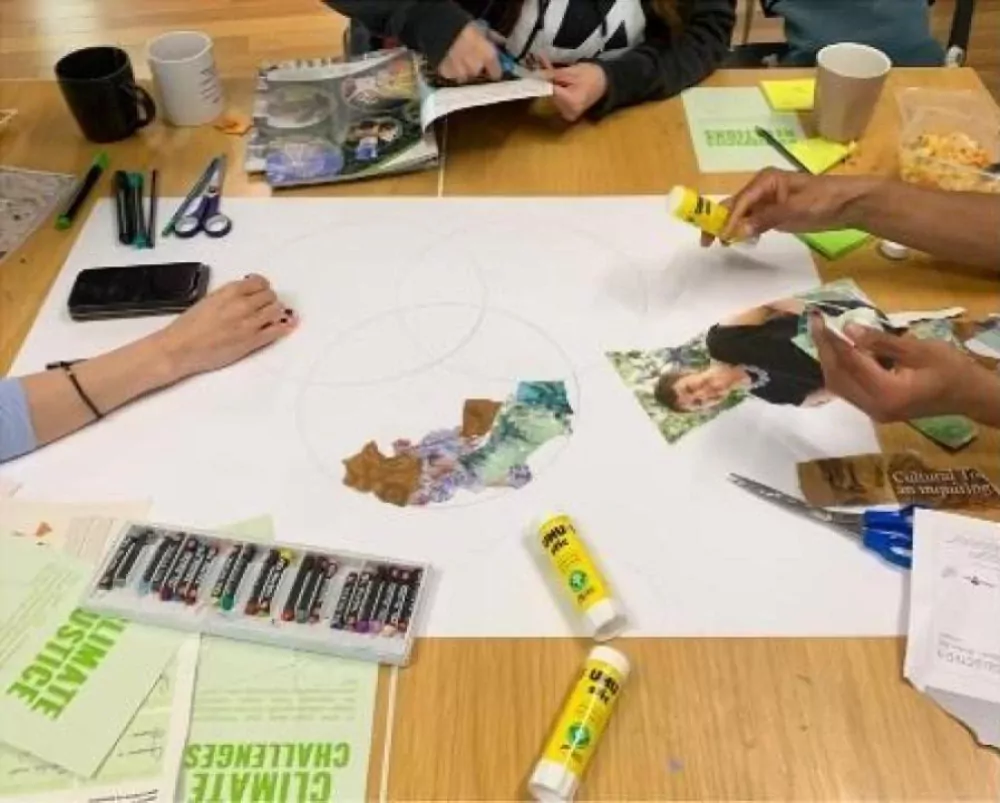
The researcher applied speculative ethnography as mode of inquiry across three research-creation Labs held in various Australian cities. Each lab unfolded as a three- to five-hour workshop where participants were invited to reimagine the city as a space of collaboration between humans and nature in response to climate challenges. In Magandjin/Brisbane, the researcher engaged a group of artists; in Narrm/Melbourne, the researcher worked with city residents; and in Boorloo/Perth, the researcher invited a group of scholars. Across these encounters, 55 participants collectively imagined 15 alternative possibilities, that took shape through the creation of visual artworks and the writing of short fictional stories (Jacobs, 2025; Jacobs et al., 2025). Speculative ethnography provided the methodological thread, guiding participants through the process of imagining, making, and storytelling.
Description
Speculative ethnography is both a creative and critical mode of inquiry that prompts one to imagine, design, and story alternative worlds (Dong et al., 2020; Sangarasivam, 2022; Bogdanova & Jacobs, 2022). It does not set out to report on pre-existing future visions, but rather opens a space for creating new imaginaries.
In combining speculative thinking and doing with ethnography, the researcher draw on Sarah Pink’s understanding of ethnography as “a process of creating and representing knowledge or ways of knowing that are based on ethnographers’ own experiences and the ways these intersect with the persons, places and things encountered during that process” (Pink, 2013, p. 35). Extending Pink’s understanding, speculative ethnography can be understood as a way of worlding that understands speculative thinking as a process that closely connects to lived experiences and to the material and temporal dimensions of place. Imagining alternative worlds through speculative ethnography relies on one’s being-in-the-world, including one’s embodied presence and attentiveness (as an alternative to ethnographic observation) and one’s encounters across human and more-than-human relations (as an alternative to interviews).
In practice, speculative ethnography can be guided by four ‘enabling constraints:’ imagining (otherwise), emplacing and situating, making and doing, and (sensory) storytelling.
To imagine otherwise, is to unlearn, to story differently, and to envision worlds that make conventional discourses and paradigms unthinkable (Haraway, 2016).
To emplace and situate is to let imagination respond to and engage with the very place in which imaginary think emerges.
To make and do is to give imagination a material pulse through artistic practice in which gestures, textures, and rhythms generate new thoughts (Springgay, 2022).
To story sensorially is to let imagination move and feel, to write and narrate color, smell, sound, and emotion, evoking what it means to inhabit these emerging worlds (Pink, 2013).
Engagement with more-than-human entities
While speculative ethnography can open countless directions for reimagining worlds, my own use of the method has centered on multispecies reimagining. In this context, the aim was to imagine radical, alternative, multispecies possibilities that respond to climate change within a specific local setting, particularly, Australian cities.
This multispecies dimension was embedded in the enabling constraints discussed above. Each enabling constraint took a multispecies inflection:
To imagine otherwise, participants gave voice to nature by writing testimonies from the perspective of an other-than-human (e.g. the ocean, the weather, a bug) experiencing a climate challenge.
To emplace and situate, we walked through the city, letting streets, plants, and waterways guide our reimagining of human-nature collaboration.
To make and do, participants visualized their multispecies imaginaries, pausing to ask: Who benefits? Who is harmed? What new relationships emerge?
Through sensory storytelling, participants translated their visions into fiction, describing the colors, textures, sounds and emotions of multispecies collaboration.
Interpretation as “retracing”
Speculative ethnography, with its emphasis on imagining alternative worlds, challenges conventional empirical approaches in the humanities and social sciences that claim to objectively represent reality. As many scholars have argued, objectivity in research conceals the positionality and subjectivity of the researcher. In striving for neutrality, objectivity, validity, and rigor, research practices risk becoming “the research (not just findings but the modes of engagement) inevitably becomes reductive of the world" (Dewsbury, 2010, p. 4). In response to these limitations, and amid growing calls for methodological experimentation for responding to the complexity of our time, an increasing number of scholars have turned to research practices grounded in imagination and speculation. De Freitas and Truman (2020), for instance, use literary speculative fiction as a means to challenge and rethink dominant empirical research methods. Within this context, speculative ethnography is not concerned with representing and reporting on reality as it is, but it operates as a mode of inquiry that traces emerging imaginaries of worlds to come.
Is there a toolbox in development?
The researcher is still developing a conceptual and methodological understanding of the praxis of speculative ethnography.
References
Bogdanova, E., & Jacobs, A. (2021, June 3). Beyond the human: The Hague’s speculative lives. Stroom: Walking Seminar. https://walkingseminar.stroom.nl/app/uploads/2021/07/BeyondtheHuman.pdf
De Freitas, E., & Truman, S. E. (2021). New empiricisms in the Anthropocene: Thinking with speculative fiction about science and social inquiry. Qualitative Inquiry, 27(5), 522-533.
Dewsbury, J. D. (2010). Performative, non-representational, and affect-based research: Seven injunctions. The SAGE handbook of qualitative geography, 321-334.
Dong, F., Sterling, S., Schaefer, D., & Forbes, H. (2020, May). Building the history of the future: a tool for culture-centred design for the speculative future. In Proceedings of the Design Society: DESIGN Conference (Vol. 1, pp. 1883-1890). Cambridge University Press.
Haraway, D. J. (2016). Staying with the trouble: Making kin in the Chthulucene. Duke University Press.
Jacobs, A. (2025). Speculating-with other-than-humans in multispecies climate fiction: Canopy of the Hidden Alley. Australian Journal of Environmental Education, 41(3), 616-632.
Jacobs, A., McKenzie, M., & Truman, S. E. (2025, June 21). Emplaced speculation: Imagining multispecies worlds in the colonial ruins of the Anthropocene. SSRN. https://doi.org/10.2139/ssrn.5315011
Pink, S. (2013). Doing Visual Ethnography, third edition. Sage.
Sangarasivam, Y. (2022). Nationalism, Terrorism, Patriotism: A Speculative Ethnography of War. Springer International Publishing.
Springgay, S. (2022). Feltness: Research-creation, socially engaged art, and affective pedagogies. Duke University Press.
Links
-converted.webp)
-converted.webp)