Platform Cooperative Guide
Described by Anannya BhowmikDescription
Platform Cooperative Guide and Coop Deck
Context
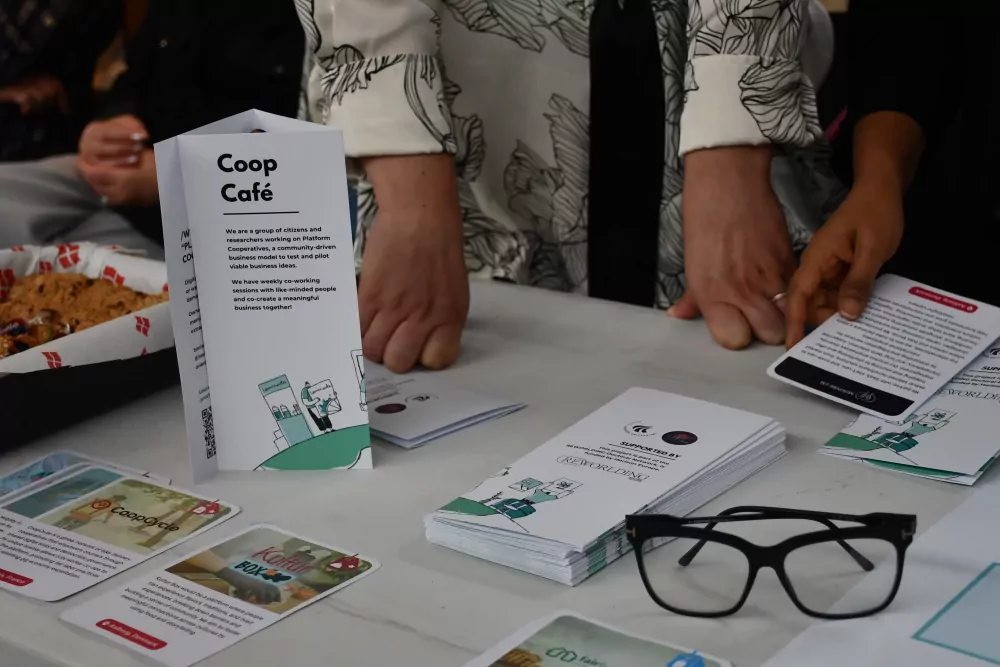
The Platform Cooperative Guide and Coop Deck were developed during the ReWorlding project for entrepreneurial citizens and can be used during ideation sessions, in self-organised groups or individually. They were first tested at the International House North Denmark and Aalborg Library, and will later be made publicly available online.
Description
Platform Cooperative Guide, accompanied by the Coop Deck, was designed upon reflecting the needs and worldviews of research participants - how they might look at platform cooperatives. For them, if it is a way of doing business, that goal needs to be clarified. Here “cooperativism” took a back seat, and the concepts evolved as a reflective aspect.
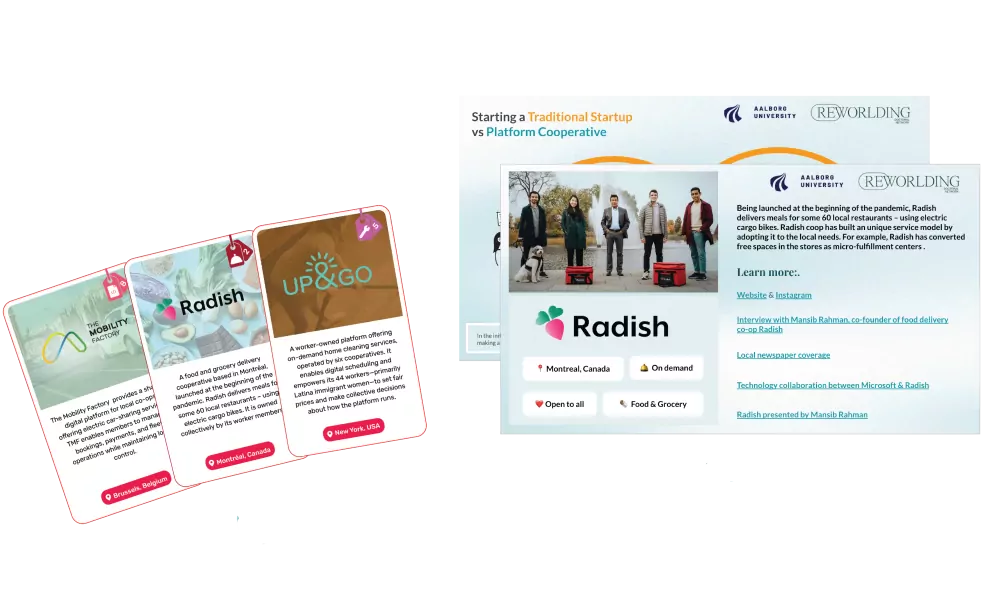
Coop deck consists of 14 different platform cooperative cards around the globe, and new cases are being updated at regular intervals. Each card had a concise description, headquarter location along with a small icon denoting the service category, such as food delivery, digital goods, hospitality, etc. The information on these cards was crafted to spark curiosity at a glance by providing the key information such as service offerings, scale of business etc. The back of the card had the QR code, upon scanning, the participants would land in the Platform Cooperative Guide. The guide had the detailed description of the platform cooperative along with related newspaper articles, research papers, podcasts, etc. These tools serve as an onboarding tool of communication as a new participant engages in the conversation with the researcher. Hence, these tools are constantly getting updated with each citizen interaction; for example, an FAQ section related to profit sharing was added based on the multiple discussions and interactions that took place within this group.
Engagement with more-than-human entities
This toolkit could expand on technology as “more-than-human”; and mediate conversations about technological ethics and governance, helping communities negotiate how technologies shape platform cooperatives
Just as Coop Deck curates traces of platform cooperatives, a similar approach could be used to map and visualise socio-ecological infrastructures involving non-human actors - such as pollinators, water systems, soil microbes, or urban wildlife. Each card could represent a species or ecological process, highlighting its role in sustaining human and non-human life, its vulnerabilities, and its interactions with human activities. QR codes could link to multimedia resources (scientific studies, indigenous knowledge, podcasts) that deepen understanding of these interdependencies.
Interpretation as “retracing”
The toolkit resulted from the retracing practice of curating knowledge about global platform cooperatives, from the angle that is useful for the targeted population i.e. unemployed residents of Aalborg considered as marginalised population.
The iterative updates, such as adding FAQs based on citizen interactions - reflect a continuous retracing process, where knowledge is not static but evolves through dialogue and collective sense-making. This dynamic approach challenges dominant narratives of platform capitalism by surfacing alternative practices and values, enabling participants to critically reflect on what infrastructures exist, how they operate, and what socio-economic imaginaries they embody.
Case study
These tools were created prior to the Ideation Workshop organised on 20th May, 2025, at IHND premises to explain the concept of platform cooperatives that could create jobs for themselves.
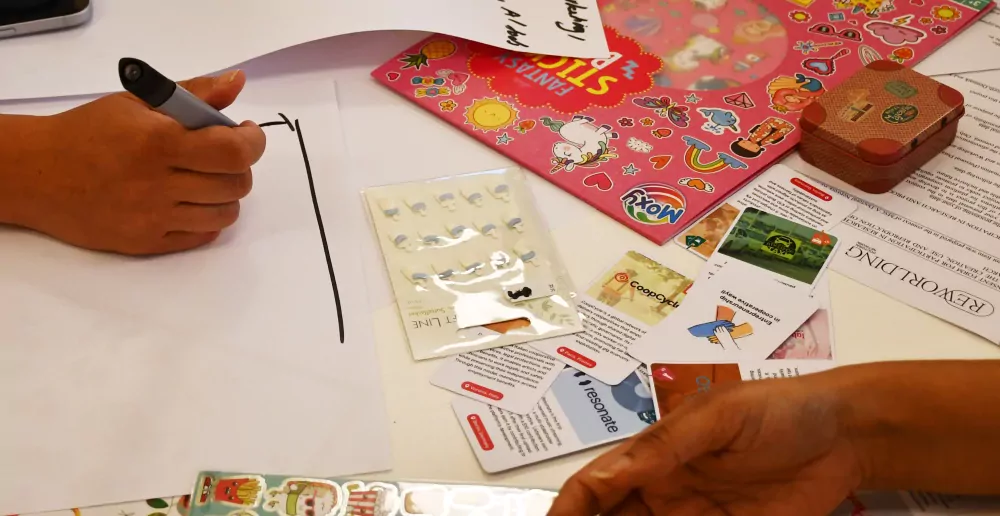
Followed by an icebreaking session and brief presentation on the platform cooperative model, Coop Deck was introduced to the self-organised participant groups to come up with a business idea or reimagine their business in cooperative form.
Toolbox
A toolkit is being developed to support entrepreneurial citizens. The toolkit is still in a prototype phase and will be available online soon on the ReWorlding website.
References
Palmieri, T., Huybrechts, L., & Devisch, O. (2019). Co-producing, curating and reconfiguring dwelling patterns: A design anthropological approach for sustainable dwelling futures in residential suburbs. Design Studies, 64, 101011. https://doi.org/10.1016/j.destud.2019.04.002
Bødker, S., Dindler, C., Iversen, O.S., Smith, R.C. (2022). What Are the Tools and Materials of Participatory Design? Participatory Design. Synthesis Lectures on Human-Centered Informatics. Springer, Cham. https://doi.org/10.1007/978-3-031-02235-7_6
Sanders, E. B. N., & Stappers, P. J. (2014). Probes, toolkits and prototypes: three approaches to making in codesigning. CoDesign, 10(1), 5–14. https://doi.org/10.1080/15710882.2014.888183
Huybrechts, L., Devisch, O., Zuljević, M., Bidwell, N., Teli, M., Seravalli, A., Light, A., Antoniadis, P., De Blust, S., Bassetti, C., Storni, C., Marshall, M. T., Avram, G., Tassinari, V., Majetić, F., & Declerck, J. (2022). Reworlding: Participatory Design Capabilities to Tackle Socio‑Environmental Challenges. Proceedings of the Participatory Design Conference 2022 – Volume 2, 173‑178. ACM. https://doi.org/10.1145/3537797.3537870
Links