Change the Script
Described by Nikolas Kanavaris (Author of the practice)Description
Context
The workshop was developed within the “Common Waste - Common Libraries” project by the Goethe-Institut Southeastern Europe. The focus of the “Change the Script” project is to reimagine library spaces as commons, places where emotional encounters, collaboration, and shared creativity can unfold. The project prototype was implemented at the Vladimir Nazor Library in Zagreb and was funded by the Goethe-Institut Kroatien and the Culture Moves EU mobility program. The Change the Script_craft version was realised with the cooperation of the Goethe-Institut Athen and the B.P.M. Cultural Group, and took place in May 2025 in the Goethe-Institut Athen’s Library and workshop spaces.
Description
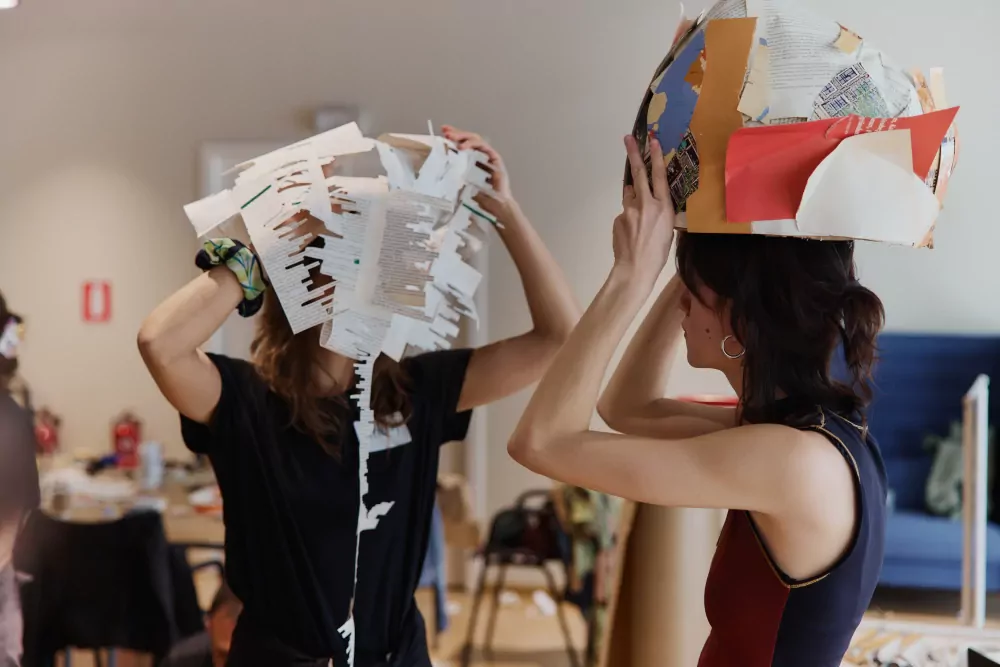
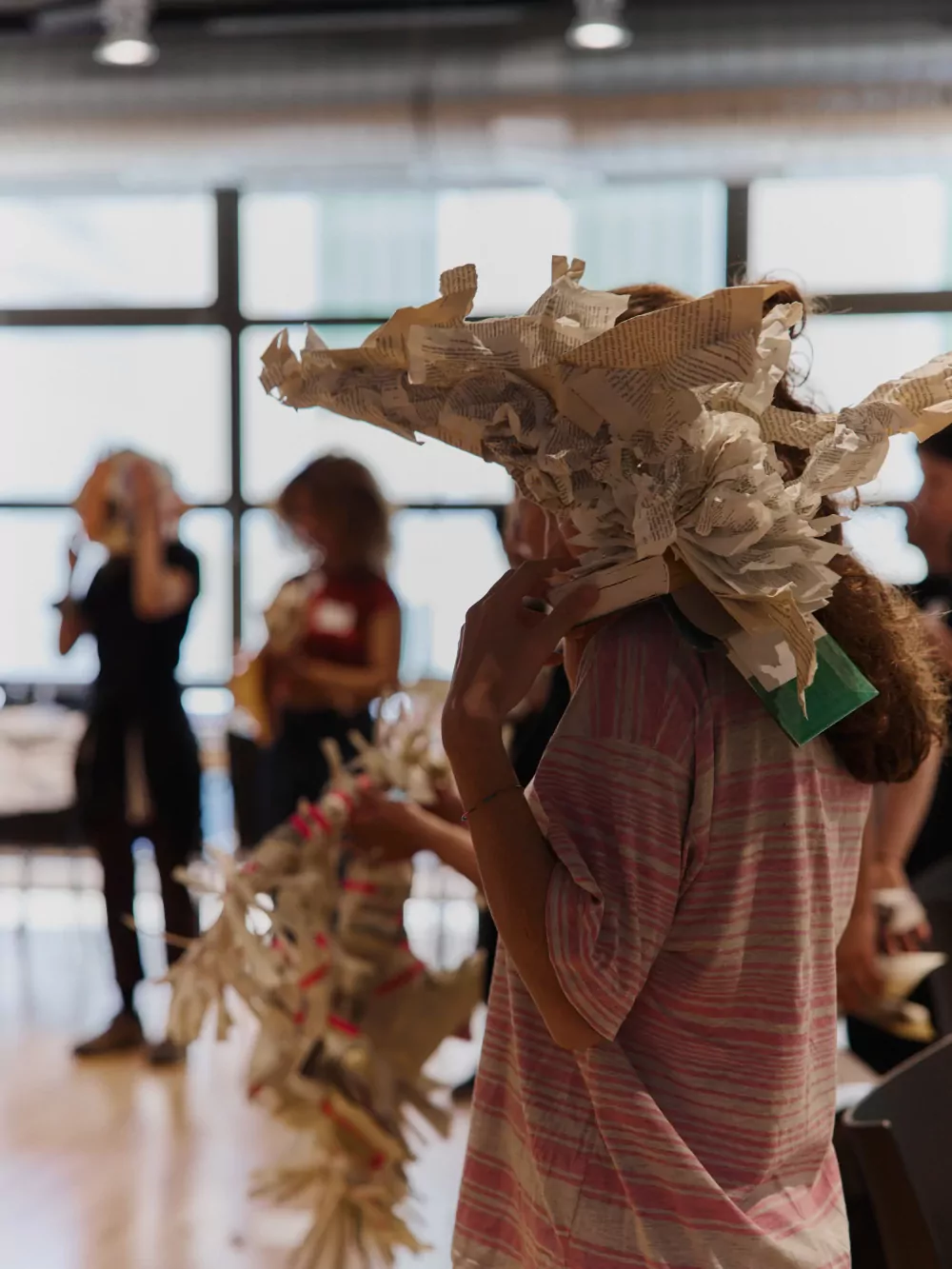
Change the Script (craft version) is a three-day co-performance design workshop grounded in costume scenographics. Participants create performative objects from discarded books and use them in solo, group, and collective performances. Its goal is to develop a costume-based method in which crafting and performing become inseparable practices of engagement and connection among participants who are unfamiliar with each other.
On the first day, participants are introduced to the library space and the materials: books of various sizes, colours, and paper qualities, along with tools such as glue and cutters. Through playful interaction with paper, they explore its potential; its assemblies, supports, joints, flexibilities, rigidities, surfaces, volumes, textures, and tones. Working individually, they transform book pages into scenographic compositions. The day concludes with one-minute silent improvisations titled The Birthmoment of My Plasma (Creature).
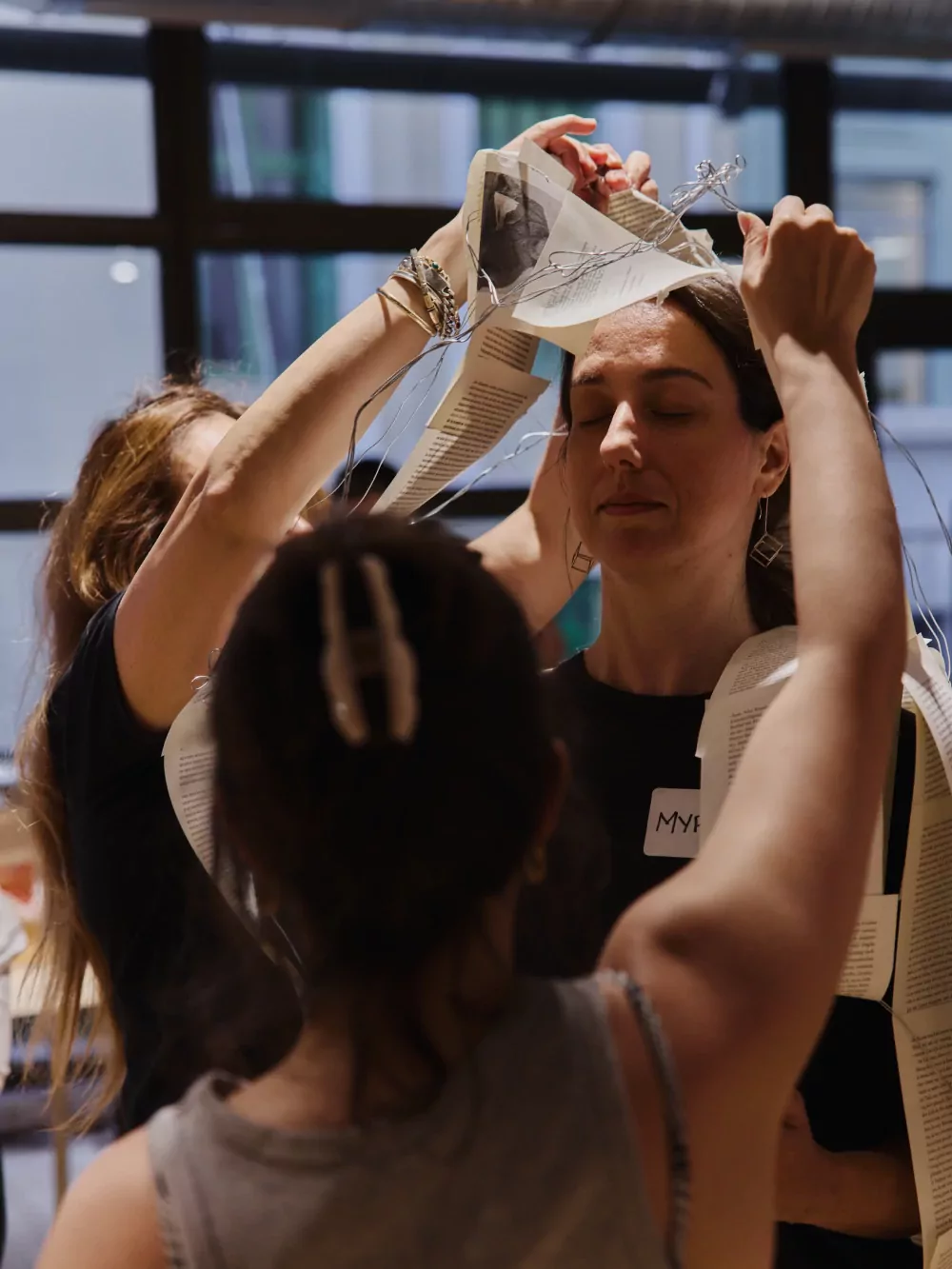
On the second day, the warm-up focuses on balancing the body in relation to the objects created on the first day. Participants are instructed to form pairs through their objects. Swapping becomes important: through giving and taking, dressing and undressing, they form new relations with one another. Groups of six are then created to explore the connections between their objects. Each group first creates a still image, photographs it, and then participants individually rework their objects based on this shared encounter. The session concludes with a three-minute group improvisation titled "The First Encounter of Plasmata (Creatures)."
On the third day, the warm-up takes place inside the library space, where the public performance will later unfold. Participants move through the space with their objects, navigating it and becoming familiar with its dynamics. They are then asked to “install” their group encounters in specific parts of the library and to begin performing the improvisations developed on the second day. The final public presentation begins with each participant returning to the “birthplace” of their object, followed by a sequence of encounters distributed throughout the library. The workshop concludes with a collective roundtable discussion.
The workshop builds on the discourse on Expanded Scenography (McKinney & Palmer, 2017) and Costume Scenographics (Hann, 2023). Practically draws on Tadeusz Kantor’s bio-objects (Witts, 2010), Jacques Lecoq’s methods (Lecoq et al., 2001), particularly the L.E.M. program, Barbieri’s (2013) dress performance practice and community costume practice (Østergaard, 2018).
Engagement with more-than-human entities
More-than-human perspectives have the potential to become embodied, affective experiences through the use of costume. Costumes, while physically close to and connected with the wearer, act as independent material mediators between the body and the world. Rather than producing an exact representation of the body, they shape multiple appearances and open up diverse bodily experiences.
In this workshop, discarded books were used to craft costumes, establishing a new relationality between the Library and the participants. Books, as material objects, are tied to knowledge and carry the memory of the intimate act of reading, yet they also become waste when libraries renew their catalogues. Tearing books apart, especially within a library, can feel like an act of desecration, exposing their paper materiality.
These more-than-human paper worlds, once existing as books, were reformed into costume elements, gaining a new proximity to the body. Performing through paper costumes achieved two things: it transformed the library from a distant institutional space for archiving books into a place of embodied knowledge, participation, and connection; and it “gave voice” to books as more-than-human material entities. Books were “rewritten” and performed in space as their pages, full of printed words, moved and danced.
Interpretation as “retracing”
By foregrounding appearance and the body, the workshop unsettles the cognitive and verbal hierarchies that typically structure participatory processes. Participants are invited to wear comfortable black clothing, an intentional, minimal “first costume” that levels distinctions in style, status, and self-presentation. This subtle transformation sets the tone for entering the space differently, as bodies ready to work, sense, and improvise. This entry is reinforced by skipping formal introductions and biographies, and focusing on body and material warm-ups, as well as spontaneous directions. Through these “costumed entries”, the workshop attempts to cultivate improvisation, temporarily suspend normative hierarchies, and open space for shared agency in the co-design process.
Case study
Paper-made masks and costumes acted as mediating artefacts that enabled participants to step out of their social role and playfully explore alternative identities.
“Throughout the days I was free; I didn’t know the affiliation of the other participants, and I was just playing with paper.”
Costume scenographics appear to give voice to participants. As one participant recalled: “While I thought performance was something I didn’t like at all, through the creature, it became much more enjoyable. I wasn’t really the one at the centre; it was.” Many participants shared similar reflections.
“The first day, I was incredibly afraid to expose myself [...] On the second day, I was very proud that I had already dared to do it once, and on the third day, I was almost not afraid at all. The fact that I made a mask helped me a lot to take the leap.”
Costumes provided a sense of courage and a means to connect with the other participants.
“The first day, I was very excited. After the performance, to be honest, I felt quite tired [...] On the second day, I was excited from start to finish, and on the third day, when I realised that the project had ended, I felt moved.”
Is there a toolbox in development?
The scheme is used to communicate to participants the general structure of the three-day workshop. It provides a general understanding while leaving space for surprises.
Change the Script_Workshop Scheme.pdf
The reflection kit is used to enable an individual exploration of the costuming practice along the days of the workshop.
Change the Script_reflection kit.pdf
References
Barbieri, D. (2013). Costume Re-Considered, front the scenographic model box, to the scenographic body, devising a practice-based design methodology that re-focuses performance onto costume. In. Hellenic Costume Society.
Hann, R. (2016). Costume Politics. In (pp. 112-131).
Hann, R. (2023). Costume Scenographics. In C. Lindgren & S. Lokter (Eds.), Costume Agency (pp. 203-211). Oslo National Academy of the Arts (KHiO).
Lecoq, J., Carasso, J. G., & Lallias, J. C. (2001). The Moving Body: Teaching Creative Theatre. Routledge.
Light, A. (2024). More-than-Human Participatory Approaches for Design: Method and Function in Making Relations Proceedings of the Participatory Design Conference 2024: Exploratory Papers and Workshops - Volume 2, Sibu, Malaysia. https://doi.org/10.1145/3661455.3669862
Lindgren, C., & Lotker, S. (Eds.). (2023). Costume Agency Artistic Research Project (1 ed.). Oslo Natioal Academy of the Arts.
McKinney, J. e., & Palmer, S. e. (2017). Scenography expanded : an introduction to contemporary performance design. London ; New York.
Pantouvaki, S., Fossheim, I., & Suurla, S. (2021). Thinking with costume and material: a critical approach to (new) costume ecologies. Theatre and Performance Design, 7(3-4), 199-219. https://doi.org/10.1080/23322551.2021.2002056
Witts, N. (2010). Tadeusz Kantor. Routledge. https://doi.org/10.4324/9781351056786
Østergaard, C. (2018). MASK: Dialogue between an inside and an outside perspective of costume. Studies in Costume & Performance, 3(1), 61-80. https://doi.org/https://doi.org/10.1386/scp.3.1.61_1
Credits photography: Nikos Katsaros
Links