Walking-in-soil & Working-in-soil
Described by Leen Vansteenkiste, based on Ron Wakkary’s Nomadic PracticesDescription
Context
Walking-in-soil and working-in-soil were explored in the context of the infrastructural transition project Noord-Zuid Limburg (NZL), in Flanders, Belgium. Walking-in-soil and working-in-soil were explored in the context of Project Noord-Zuid Limburg (NZL) in Flanders, Belgium. Project NZL concerns a high-traffic road that connects the Belgian city of Hasselt and the Dutch city of Eindhoven, currently affecting the quality of life, road safety, mobility, and the present water landscapes. The Flemish government, government agency De Werkvennootschap, and design and research consortium Studio NZL initiated the design process for a sustainable alternative road design (Vlaamse regering, 2025).
This new road design requires the construction of tunnels underneath the municipality of Houthalen-Helchteren, the expropriation and demolition of buildings and gardens, as well as the removal of materials and plants they contain (e.g., trees, soils, bricks), and the reuse of excavated soils in the redesign of public spaces and landscapes (Vlaamse regering, 2025). However, the planned excavations could erase centuries of soil life in an instant, making soils important yet fragile actors in the project. The large-scale aim of incorporating more-than-human entities, such as soil, into the planning and design processes of Project NZL is a new, uncertain, specialised and technical terrain. This highlights the need for smaller-scale, temporary and participatory approaches that engage with more-than-human entities, such as soils, in spatial planning and design processes, to inform larger-scale approaches.
Description
Walking-in-soil is a research practice developed to explore large-scale research contexts in search of soil practices (e.g., composting, depaving, uprooting plants, etc.). Working-in-soil is a research practice developed to explore soil practices more in-depth and on-site through participatory design and prototyping experiments. Both practices stem from Ron Wakkary’s (2020) posthuman theory on nomadic practices. Nomadic practices aim to expand the way we understand design (Wakkary, 2020) by decentering human-centred worldviews (Wakkary, 2021), where the perception of soil as a living environment is limited, and by exploring design as relational. By being in the field, moving around and getting our hands dirty, we can learn how designing-with (Wakkary, 2021) the soil could produce situated knowledge of the soil in an embodied way.
The neglect of the embodied act of walking can be seen as an underlying cause of modern society’s “groundlessness” (Ingold, 2011, p.44). Our connection with the ground is influenced by “the experience of walking in boots or shoes over paved surfaces” (Ingold, 2011, p. 44) or by more efficient modes of transportation (Springgay & Truman, 2019). Walking can be leveraged into the nomadic practice of walking-in-soil to retrace our connection with the soil and explore everyday soil practices across large-scale research areas.
The act of working initiates engagement with a particular soil practice through participatory design and on-site prototyping experiments. As argued by Tironi et al. (2023), the act of prototyping can facilitate the exploration of situated methods for engaging with more-than-human entities. Speculative works, as part of prototyping, can make more-than-humans, such as the soil, more tangible and visible through the traces made in processes of negotiating design (Tironi et al., 2023). Working can be leveraged into the nomadic practice of working-in-soil to explore everyday soil practices in-depth in situated environments of large-scale research areas.
Engagement with more-than-human entities
Walking-in-soil and working-in-soil both support engagement with soils and their associated soil practices.
Interpretation as “retracing”
Walking-in-soil supports an embodied nomadic movement across a research environment through which everyday soil practices can be noticed and retraced. Working-in-soil supports a more in-depth engagement with a retraced soil practice by exploring in a situated way how we are entangled with soil through designing and prototyping with soil practices on-site.
Case study
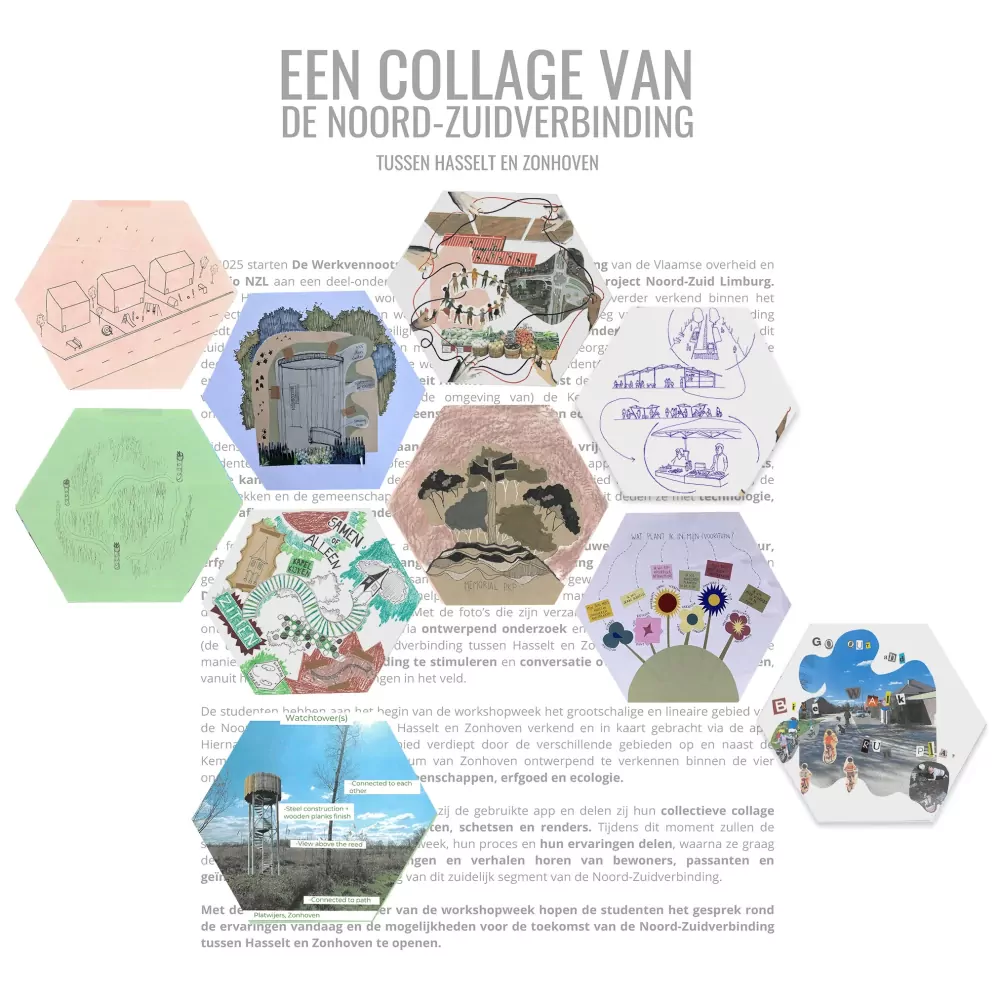
Walking-in-soil and working-in-soil were explored during a workshop week from March 31st to April 4th, 2025, by bachelor students and researchers from the Faculty of Architecture and Arts of UHasselt in the context of Project NZL. Through the exploration of walking-in-soil, students noticed soil practices across the research area, such as a pet cemetery that preserved the scattered ashes of deceased pets, allowing also the soils to be undisturbed, or front gardens of a neighbourhood that were arranged as playgrounds, preventing the gardens from being paved, and a village centre where a river became central to its design, making a visual connection of two water landscapes. Through the exploration of working-in-soil, the students prototyped different futures for Project NZL based on the soil practices they retraced. Speculative designs, such as a pavilion for the pet cemetery, designed to address the act of care happening underneath our feet, or a street with front yards turned into connected playgrounds, to address that linear and large-scale can also be playful and caring, and an observation tower to make the water landscapes around Project NZL more visible and tangible. These and other speculative designs, regarding soil, as well as other more-than-human and human entities, were combined into a collective collage, visualising a speculative future for Project NZL.
Is there a tool in development?
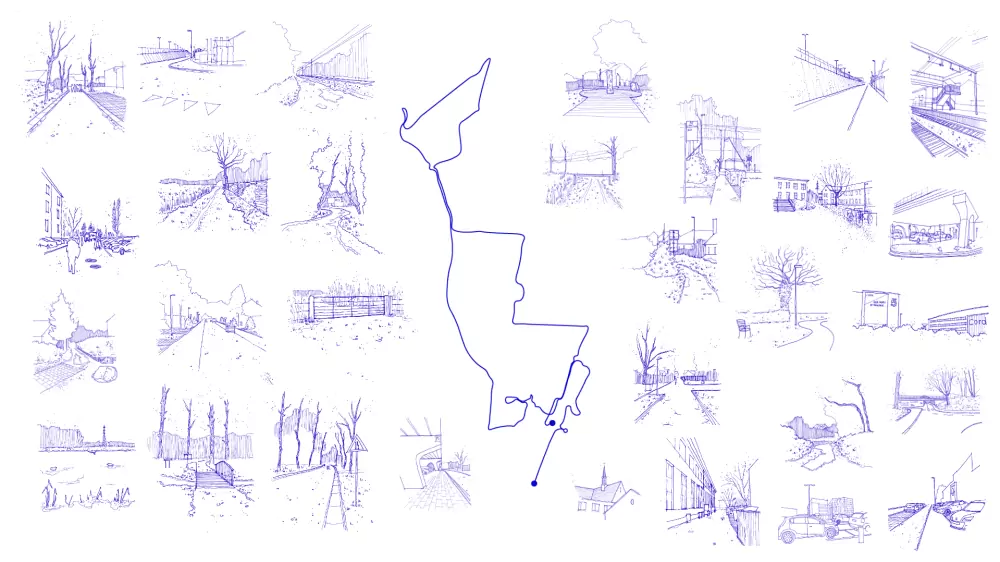
Walking-in-soil is explored in a series of observatory walks across Project NZL. For these walks, a starting and arriving point were predefined, while the route in between was open to nomadic wandering, making the walks a result of on-site decisions based on how inviting a route looked (e.g., unpaved paths leading into a natural area). This was documented in maps of the walks, including drawings of in-the-field perspectives. These maps challenge the often top-down maps of large-scale spatial planning projects by visualising what happens on the ground and which more-than-human entities (e.g., unpaved soils, trees, water landscapes) are encountered here.
References
Ingold, T. (2011). Being Alive: Essays on Movement, Knowledge and Description. Routledge.
Springgay, S., & Truman, S. E. (2019). Walking methodologies in a more-than-human world: WalkingLab (First published in paperback). Routledge.
Tironi, M., Chilet, M., Marín, C., & Hermansen, P. (2023). Design For More-Than-Human Futures: Towards Post-Anthropocentric Worlding (1ste dr.). Routledge. https://doi.org/10.4324/9781003319689
Vlaamse Regering. (2025). Projectbesluit NZL - Fase 1 [Report]. Accessed October 29, 2025. https://www.noordzuidlimburg.be/
Wakkary, R. (2020). Nomadic practices: A posthuman theory for knowing design. International Journal of Design, 14(3), 117-128.
Wakkary, R. (2021). Things we could design: For more than human-centered worlds. The MIT Press.
Links
-2-converted.webp)