Platform Cooperative Compass
Described by Anannya Bhowmik PaulDescription
Context
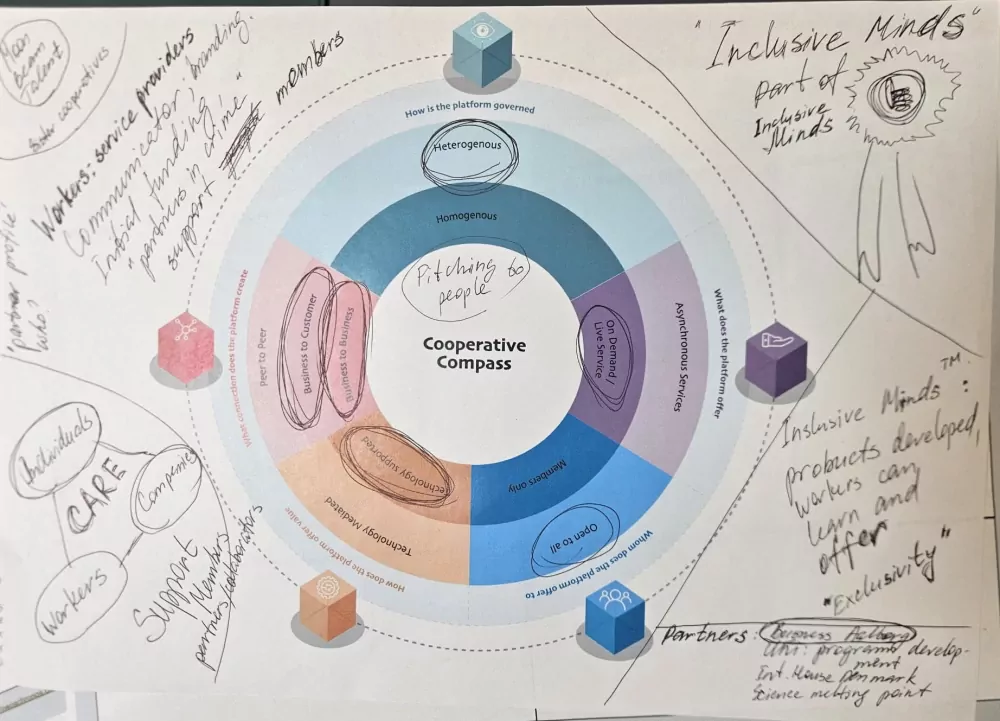
The researcher engages with entrepreneurial citizens during ideation sessions and team reflections at IHND and Aalborg Library, where the Platform Cooperative Compass is introduced as a tool to explore and make sense of platform cooperativism. These interactions are grounded in a situated understanding of local concerns and are intended to inform a broader toolbox that will later be made accessible through digital media.
Description
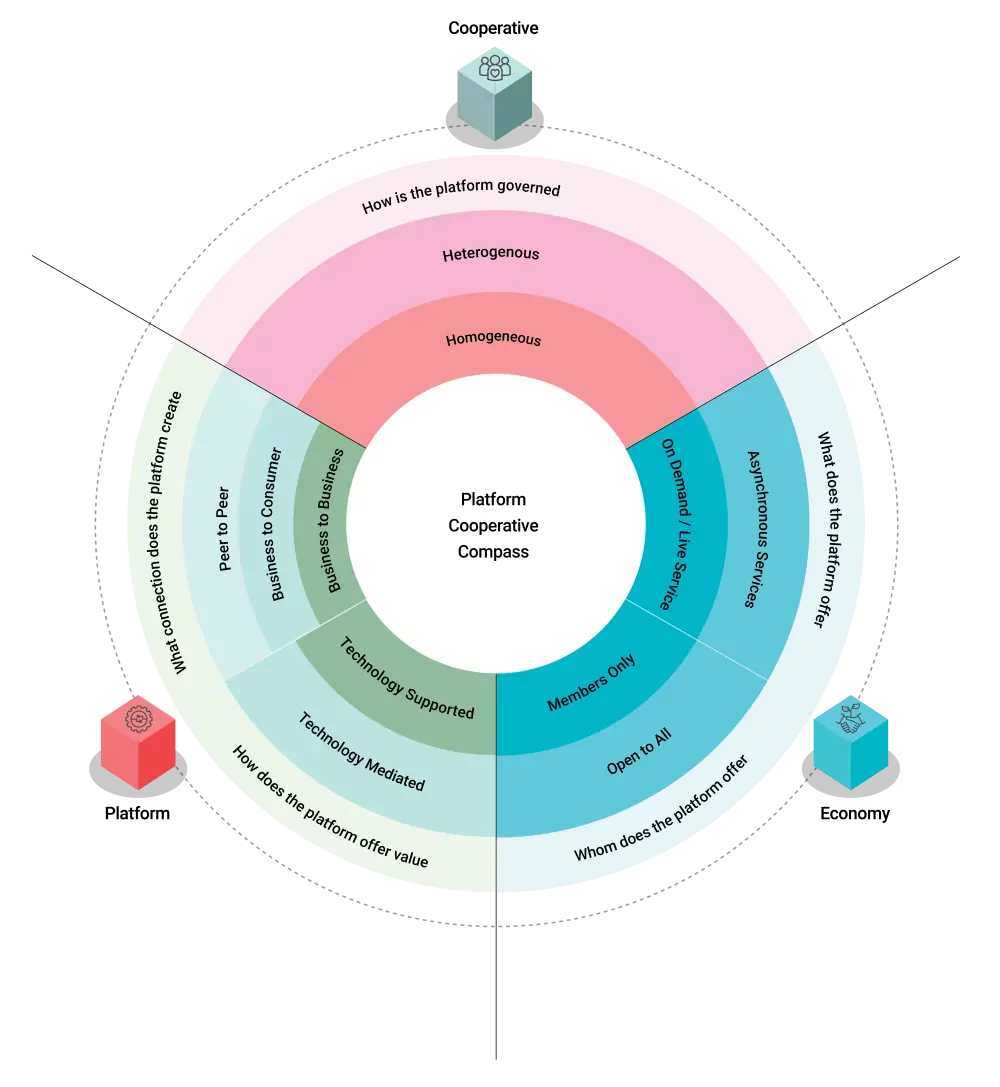
The Platform Cooperative Compass is a simplified conceptual tool designed to demystify the complex model of platform cooperativism for people unfamiliar with cooperative thinking, especially those exploring new livelihood opportunities outside traditional employment options.
The compass emerged from three interconnected strands of knowledge-building:
-
1. Extensive Literature Review
A synthesis of academic work on platform cooperatives, platform economies, and democratic governance.
-
2. Global Case Collection
Gathering and analysing examples of platform cooperatives worldwide, noting governance models, value distribution, service categories, ownership structures, and operational principles.
-
3. Situated Knowledge from Aalborg
Through observations, participation in public events, informal conversations, and listening to concerns of marginalised residents, the researcher identified what creates confusion, what triggers worry, and which aspects require clarity for residents to meaningfully imagine building or joining a platform cooperative.
Engagement with more-than-human entities
This toolkit expands on technology as “more-than-human” and mediate conversations about technological ethics and governance, helping communities negotiate how technologies shape platform cooperatives.
Interpretation as “retracing”
The compass is itself a retracing device. It emerges from tracing:
academic knowledge, global cooperative cases, and situated context. By carefully observing citizen interactions, the researcher surfaced what counts as meaningful clarity for marginalised groups and broke them down into simple questions.
The compass retraces socio-economic infrastructures and makes visible the implicit knowledge required for understanding cooperatives. It reveals anxieties, aspirations, and conceptual gaps in the community. As a translation object, the compass bridges different actors: citizens, researchers, cooperative practitioners, and institutions. It helps them “sketch together,” creating shared language and understanding. By breaking down complex principles, the compass invites citizens to reimagine their own entrepreneurial futures.
The “cooperative” section of the compass requires contextualisation through dialogue with local actors. By engaging policymakers, municipal stakeholders, and institutions in interpreting what cooperative ownership means within Denmark’s regulatory and socio-economic landscape, the compass opens a conversation about how democratic business models can be recognised, supported, and embedded in existing frameworks—inviting institutions to reflect on their role in fostering inclusive, community-owned economic futures.
Case study
These tools were created prior to the “Ideation Workshop” organized on 20th May, 2025 at IHND premises; to explain the concept of platform cooperative that could create jobs for themselves.
The compass has been used to onboard the new members of a cooperative-in-formation to build the collective understanding of the business model. The cooperative is working on "food as experience".
Is there a toolbox in development?
The compass is part of a toolbox in development aimed at helping entrepreneurial residents explore cooperative business ideas. It will later be integrated with the Coop Deck and Platform Cooperative Guide to create a comprehensive participatory toolkit.
References
Wegner, D., da Silveira, A.B., Marconatto, D. et al. A systematic review of collaborative digital platforms: structuring the domain and research agenda. Rev Manag Sci 18, 2663–2695 (2024). https://doi.org/10.1007/s11846-023-00695-0
Zhu, J., & Marjanovic, O. (2021). A different kind of sharing economy: A literature review of platform cooperatives. In T. X. Bui (Ed.), Proceedings of the 54th Hawaii International Conference on System Sciences (pp. 4128–4137). University of Hawaii at Manoa. https://doi.org/10.24251/HICSS.2021.502
Scholz, T., Mannan, M., Pentzien, J., & Plotkin, H. (2021). Policies for cooperative ownership in the digital economy. Berggruen Institute & Platform Cooperativism Consortium. https://www.researchgate.net/publication/358637931
Links