Bewildered swimming
Described by Kseniia (xè) ObukhovaDescription
Context
To feel bewildered means to feel confused, perplexed, uncertain. It is quite common to feel bewildered when engaging with water in the anthropogenic, post-extractive industrial landscape of Flanders, Northern Belgium. Here, access to water is often under the control of governmental agencies, private holdings, industries, or reserved clubs. Common people often lack this access, making simple interactions with water a forbidden struggle.
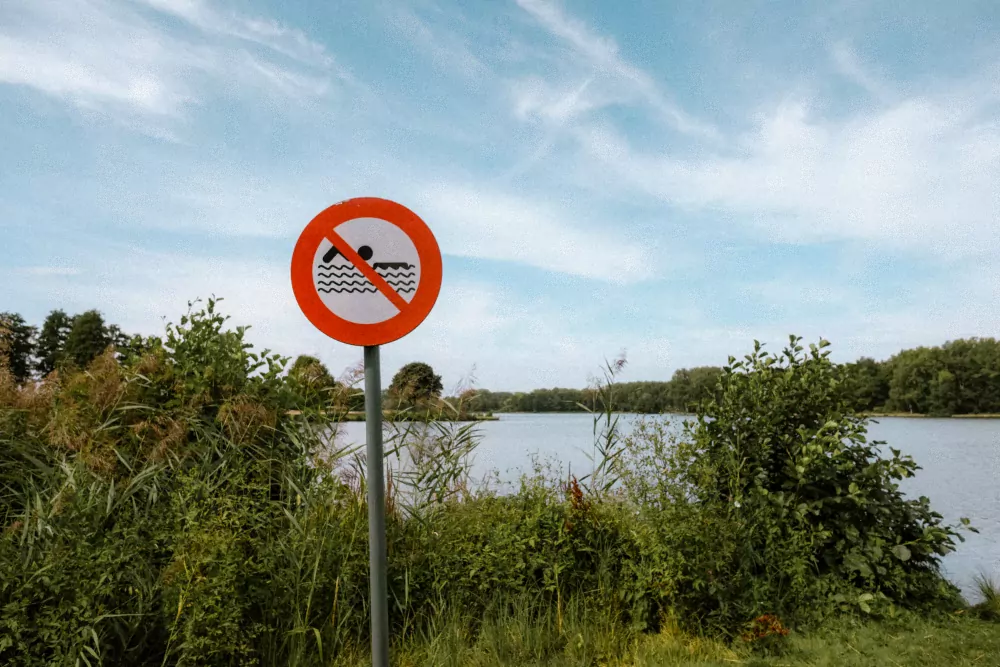
Swimming, a seemingly mundane practice, therefore becomes a practice of resistance: people still swim despite challenges and restrictions. Open water swimming (OWS) is, in fact, prohibited in most parts of the region, especially in sweet waters, be those rivers, canals, or ponds. Often driven by good intentions of policymakers, these limitations, however, tend to overcomplicate the existing relationship with waterbodies, even when conditions allow (i.e., water quality, safety, other species breeding season). Such restricted access to water precludes humans from engaging with their environment, accentuating the distance between humans and MTH even more.
Embracing the bewildered nature of swimming in a context where most engagement with water is controlled and prohibited could help us, humans, better understand the complex relationships that we already have and could still establish with our MTH surroundings. Inspired by local activists who advocate for OWS in the region, like the LZSB guerrilla swimming collective in Kortrijk, the bewildered swimming method seeks to reconnect humans with nature by getting wet, even if it is not formally permitted.
Description
Practicing swimming might seem like an easy activity. Well, it is indeed: to get in the water, one needs almost nothing—a towel and a swimsuit would do (both optional, in fact). Bewildered swimming is not much different, except that it is usually done in contexts where swimming is hardly allowed. At the same time, the challenging (and scary at first) aspects of swimming in open waters are given extra attention here! Staying afloat, breathing normally in the cold water, being aware of one’s surroundings, of things and beings that are sensed inside the water, keeping track of the currents…
Bewildered swimming is inspired by agonistic practices, and all these aspects simply reveal the often uncomfortable nature of staying in open waters. It makes us question: why is our engagement with water (and with nature in general) so surveilled? Why are we so not used to feeling and sensing waters around us, especially in post-industrial (often urban) landscapes? What makes us feel and think that waters are dirty or unswimmable? And who defines this relationship that inhabitants have with their waters?
Various activities can be done while doing bewildered swimming, including swim sessions with human and nonhuman research participants, ‘swim-along’ interviews (Denton et al., 2021), ethnographic explorations, i.e. sensory ethnography (Pink, 2015) or multispecies, more-than-human ethnographies. Being bewildered by water, encountering it in a way that is so familiar and unfamiliar at the same time, makes one reflect on a kinship that is enacted through this encounter (Laurien et al., 2025): water is not a foreign stranger. My body of water is inside another body of water. Yes, I am bewildered, but I voluntarily immerse myself in the uncertain.
Engagement with more-than-human entities
Swimming is, in itself, a way of engaging with the MTH: it is not only allowing to bodily feel what is in the water, but to imagine oneself as part of the MTH world. This happens because of a new perspective that being in the water gives you. As Kate Rew (2022) writes, “It is never about the swimming. It’s about connection with nature, connection with self and connection with others.”
Interpretation as “retracing”
Bewildered swimming is inspired by existing social movements in Flanders, who bring this practice to life through everyday bodily immersions in water. In this way, data becomes something co-produced through lived, wet engagement with environments and their nonhuman actors.
Case study
The method has been adopted as an ongoing individual practice of the researcher, and will be developed further in the next months.
References
Rew, K. (2022). The Outdoor Swimmers Handbook. Rider.
Jones, R. (Ed.). (2023). Toes in the water: Stories of lives changed by wild swimming. Vertebrate Publishing.
Denton, H., Dannreuther, C., & Aranda, K. (2021). Researching at sea: Exploring the ‘swim-along’ interview method. Health & Place, 67, 102466. https://doi.org/10.1016/j.healthplace.2020.102466
Pink, S. (2015). Doing Sensory Ethnography (2nd ed.). SAGE.
Laurien, T., Schröder, A., Zrajaeva, I., & Matt, C. (2024). Designing with Bodies of Water in the Hydrocene. In A. P. Rosén, A. Salovaara, A. Botero, & M. L. J. Søndergaard, More-Than-Human Design in Practice (1st ed., pp. 64–76). Routledge. https://doi.org/10.4324/9781003467731-7
Links