Visual Multispecies Ethnography
Described by Clara Kleininger-WanikDescription
Context
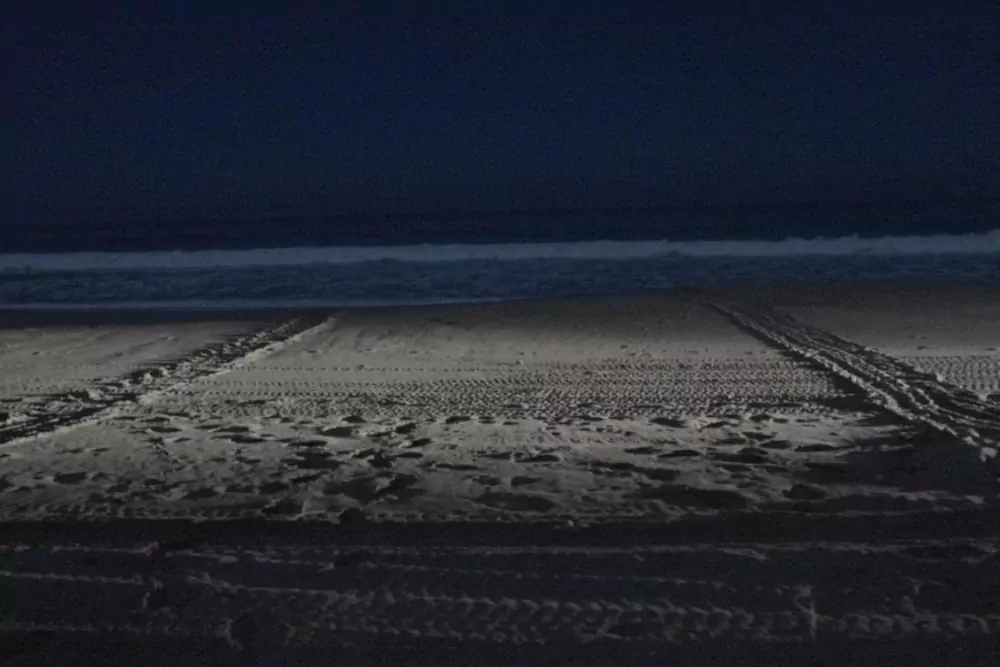
Chacahua Beach, 2023
Chacahua is a village in the Chacahua-Pastoria lagoons, one of Mexico’s oldest national parks, on the Pacific coast of the state of Oaxaca. It is inhabited by a diversity of species – hence its status as a national park - and its human inhabitants are of Afromexican, Chatino and Mixtec descent. The lagoon is nowadays confronted with complex ecological problems which have been described as ecocide and ecological racism, an overwhelming inflow of tourism, foreign investment and narcotraffic pressure.
Description
The collaborative work on a ‘visual multispecies ethnography’ – a piece of audio-visual exploration which can represent the entangled lives of multispecies inhabitants of the lagoon and the tonal ontology: sharing life with an animal, a bond between a human and an animal in the lagoon which links fate, abilities, knowledge, illness and death.
Some ideas:
-
1. during filming and fieldwork collaboration has helped sharpen my senses in the lagoon’s environment, to see, hear and feel more of what my collaborators do when they enter multispecies relationships, and this was the most fertile part of the collaboration.
-
2. audiovisual methods are particularly good for an attention to (and representation of) sensoriality, and an attention to sensoriality is a crucial part of entering multispecies relationships
3. I have been looking at Chachaua by thinking with the pluriverse, a practice of many worlds, which refuses to reduce multiplicity to oneness, as authors Marisol de la Cadena and Mario Blaser (2018) propose, inspired by a Zapatista declaration. Thinking within the pluriverse allows for many heterogeneous worlds instead of a one-world world which tries to make its logic ubiquitous. John Law proposes that a nature-culture dichotomy forms the basis of the one-world world, which tries to make extinct all other possible worldings (Marisol de la Cadena 2015) and ontologies (Law 2011). I have been looking for ways to represent the pluriverse on film and a collaborative, sensorial practice is a proposal for this.
Engagement with more-than-human entities
The entire work is based in multispecies ethnography, which looks at the matrix of human and more-than-human lives and considers more-than-human agency and interests along with human ones. More precisely the practice proposed contends that an attention to sensoriality opens space for multispecies communication: We use all our senses and the whole of our body to perceive our place in the landscape. We also use different senses to enter into exchanges: listen for more-than-human sounds and use non-symbolic signs to communicate with other living beings, as Eduardo Kohn describes in How Forests Think (2013).
Interpretation as “retracing”
For the researcher, the traces of multispecies entanglements in Chacahua are traces of multiple worlds, which is understood thinking with the pluriverse.
This has methodological implications. It suggests that, for the research, data generation requires cultivating an embodied, sensorial presence that can register these relational traces.
Retracing can help demonstrate how attending carefully to sensory and affective signals can open access to more-than-human perspectives. This pushes data collection toward practices that value situated, bodily experience. In this context, film becomes not only a mode of representation but also a tool for data generation because it creates an environment for collaboration which is attuned to multisensory entanglements that may be otherwise harder to address through written fieldnotes and descriptions.
Case study
Attached is a photo of Chacahua beach. In it, the sand of the beach is overflowing with signs of human and more-than-human activity, holes and tracks.
As I found myself riding in the back of a quad down the beach, it was moist, dark, smelled like salt, the saramuyos (ghost crabs) scuttled along, Alma, who was driving the quad, would speed along and stop right at the tracks, knowing that they lead to a marine turtle nest.
Where I saw nothing, Alma, one of the marine turtle conservationists in Chacahua, got a host of information: the species of turtle, the condition of the nest depending on how far out from the waves it was, and if the nest was from today or yesterday, as the tortugueros, Alma and her fellows, who patrol the beach every night, twice a night to rescue the recently laid eggs, would leave their own track on top of the turtle track: drive the quad intentionally over the track to mark the nest as extracted, layers of human and more-than-human traces and tracks.
Is there a toolbox in development?
A particular way of filming and editing – slow, sensorial, collaborative: what I have called a visual multispecies ethnography
References
De la Cadena, M., & Blaser, M. (Eds.). (2018). A world of many worlds. Duke University Press.
Fijn, N., & Kavesh, M. A. (2021). A sensory approach for multispecies anthropology. The Australian Journal of Anthropology, 32, 6-22.
Ginsburg, F. (2018). Decolonizing documentary on-screen and off: Sensory ethnography and the aesthetics of accountability. Film Quarterly, 72(1), 39-49.
Ingold, T. (2010). Footprints through the weather‐world: walking, breathing, knowing. Journal of the Royal Anthropological Institute, 16, S121-S139.
Kohn, E. (2013). How Forests Think: Toward an Anthropology Beyond the Human (1st ed.). University of California Press.
Law, J. (2015). What's wrong with a one-world world?. Distinktion: Scandinavian Journal of Social Theory, 16(1), 126-139.
Links
-converted.webp)
-converted.webp)