Weathering
Described by Petra Žišt - based on Neimanis and Walker, 2014; Neimanis and Hamilton, 2018; Hamilton and Neimanis, 2018; Hamilton et al., 2025; Hamilton and Neimanis, 2026.Description
Context
Weathering emerged within feminist environmental humanities as both a conceptual framework and an embodied collective practice for engaging climate change differently. It was first articulated by Astrida Neimanis and Rachel Loewen Walker (2014) as a critique of dominant climate change imaginaries, in search for a different kind of ethos in relation to climate change (different from language of urgency, contradictory scientific discourses, and spatially and temporally distance from our everyday lives). Subsequent work by Neimanis and Hamilton expanded weathering into a series of experimental, situated and participatory practices, particularly through the Weathering Collective. It is an innovative model for climate change mitigation and adaptation that brings together climate justice and community engagement, and it demonstrates how we can gradually change the world as the world changes us.
Weathering practices have been used across academic, artisitc, and pedagogical contexts, often involving small groups engaging with everyday environments, bodies, infrastructures and atmospheres.
Description
Weathering names both a condition and a practice.
Conceptually, weathering describes how bodies, places and the weather are all inter-implicated in climate-changing world and co-constitutive. Weathering describes socially, culturally, politically and materially differentiated bodies in relation to the materiality of place, across a thickness of historical, geological and climatological time.
As a practice or a tactic, to weather means to pay attention to how bodies and places respond to weather-worlds which they are also making. “To weather responsively means to consider how we might weather differently-better-and act in ways that can move towards such change.” (Neimanis and Walker, 2014) Weathering as a concept learns from a feminist politics of difference and intersectionality: not all bodies weather the same; weathering is a situated phenomenon embedded in social and political worlds, and it is never neutral. In this sense, weathering means surviving, “the total climates” (Sharpe, 2016) of racism, coloniality, misogyny, or challenges related to climate change. It means “learning to live with the changing conditions of rainfall, drought, heat, thaw and storm as never separable from the ‘total climate’ of social, political and cultural existence of bodies” (Neimanis and Hamilton, 2018). “Survivance” (Vizenor, 2009; in Neimanis and Hamilton, 2018) helps recognizing injustices, damage, neo-liberal fake, as well as the need for bodies and places to persevere. Weathering calls attention to feminist, antiracist and decolonial intersectionality, and to the need for analysis of structural and systemic violence as essential to thinking through life in a changing climate.
Weathering better requires interrupting our existing patterns of weathermaking. We need redistribution of shelter and vulnerability and feminist infrastructures for better weathering. Building on social practice theory, different social worlds require different infrastructures to be viable.
This perspective therefore expands weather beyond meteorology to include social, affective, and infrastructural atmospheres – for example, conditions of precarity, shelter, heat, exhaustion, or security. Weathering links climate change to questions of power, inequality, vulnerability, and justice.
Engagement with more-than-human entities
Weathering insists that the need for a particular kind of relation with the more-than-human environment must also stake a claim for a different kind of sociality and (interhuman) politics. It stresses “transcorporeality”, where human corporeality is inseparable from nature or environment. Through weathering, the intra-active (Barad, 2007) process of a mutual becoming, the humans and more-than-human weather form relations. Transcorporeality is an ontological orientation that expresses the imbrication of human and nonhuman natures. A transcorporeal orientation that foregrounds the connection between the weather and our corporeal selves enables us to reconsider the agency of nonhuman nature. Acknowledging the agency of nonhuman natures increases the sense of our shared presence and shared making of the weather-world. Humans and nonhuman climate and weather phenomena are co-constitutive. “We are mutually emergent, coextensive. Together we weather the world.” (Neimanis and Walker, 2014) Atmospheres, infrastructures, built environments, pollutants, energy systems, and nonhuman organisms are all actors within processes of weathering.
Interpretation as “retracing”
Embodied and creative practice of weathering help us connect bodies and weather in ways that facilitate unlearning the colonial separation of these domains. Weathering invites researchers to retrace
- how bodies register systemic processes,
- how infrastructures distribute vulnerability and shelter,
- how temporalities of a “thick time” (a transcorporeal stretching between past, present and future) coexist materially and help reimagine bodies as archives of climate and as making future climates possible,
- how environmental change is lived rather than merely measured.
It also shifts away from dominant temporality of climate change discourse and instead of “what should we do to stop climate change?” asks “how is climate change me?” and how weather also incorporates me.
Weathering produces knowledge through situated, embodied and relational sensing. It supports forms of inquiry attentive to atmosphere, affect, bodily experience and unequal exposure.
Case study
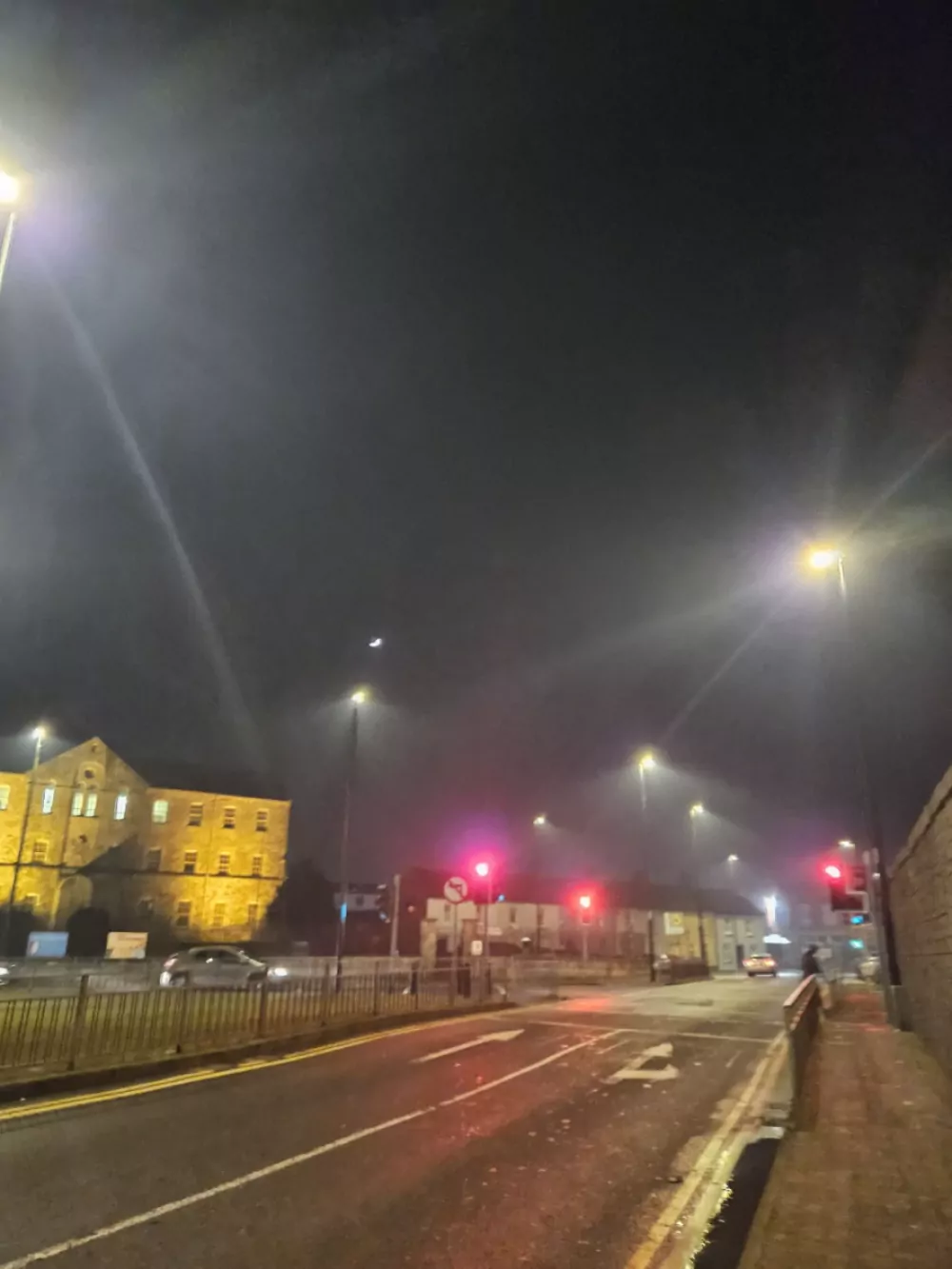
Photo 1: Evening smog in Limerick city centre, a residue of traffic, home heating, industrial activity, and weather, visible in the air, inhaled with each breath, and brough home on clothes and hair.
We “make” the weather with carbon emissions from our cars, homes and factories. We are weather makers: our collective actions and systems of living become the weather-world that in turn becomes us. This is both meteorological (through fossil fuels that release carbon into the atmosphere) and more-than-metheorological (unfolding through the social, political and economic atmospheres we reproduce or contest).
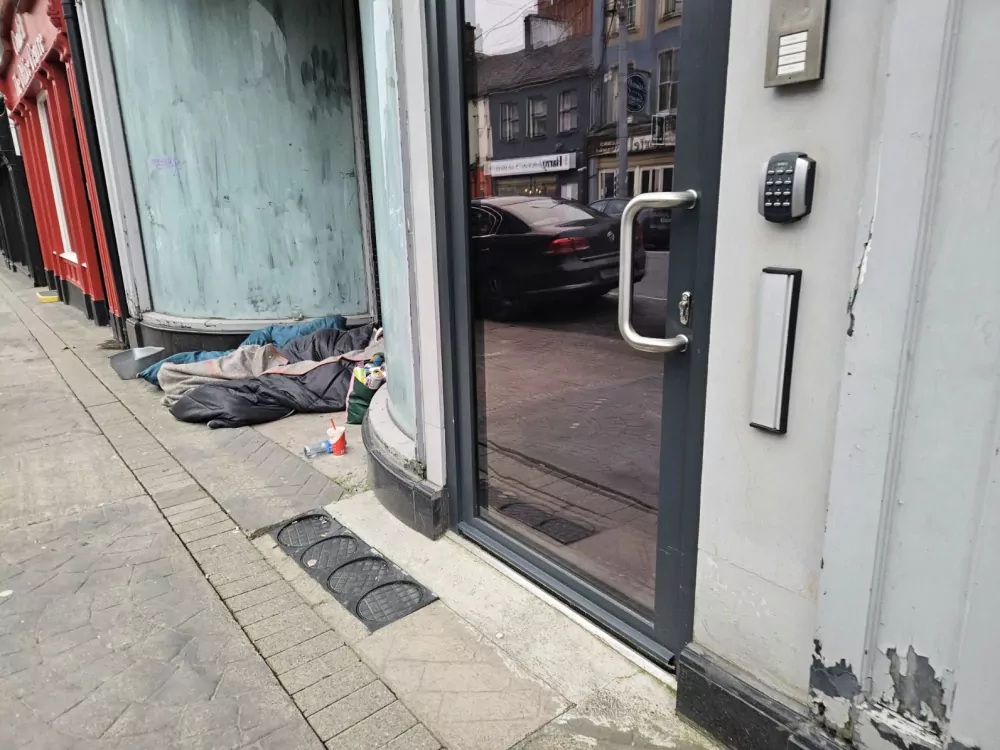
We are always weathering, yet bodies weather differently. Some weather in conditions of relative shelter (secure housing, affordable heating, infrastructural protection), while others weather without these stabilising supports.
Photo 2: Weathering is also about exposing uneven and unjust distribution of shelter and vulnerability, for instance people sleeping rough, or residents in insecure housing who cannot afford energy costs and must forgo heating and cooling.
In contemporary Western societies, the dominant ideal is to maintain personal climates as stable and predictable, enabled by walls, roofs, heating and cooling systems, and energy infrastructures. Different infrastructures facilitate different ways of weathering.
“Weathering together” draws our attention towards inclusive and transformative sense of feminist infrastructures. As Neimanis and Hamilton (2026) ask: “What is the point of making homes fully sustainable (say, with solar-passive, zero-waste renewable energy, with composting, with public and active transport commuter options), if there is no accompanying concern for systemic misogyny, private property regimes on stolen Indigenous lands, the gendered division of labour, deeply problematic policing and carceral systems, or the privatization of care?”
A weathering-oriented inquiry into energy research and energy transition is valuable because it connects environmental and social justice. It also looks at lived conditions of adaptation. Residents in renovated housing may inhabit thermally efficient dwellings designed to reduce energy consumption. Yet experiences of comfort, control, anxiety, or dependency reveal that energy transition is also a reconfiguration of embodied relations to heat, cold, automation, and infrastructure. Energy transition is not purely a technical shift but is retraced as a transformation of how bodies weather everyday life.
Within Reworlding energy transitions, we approach social housing energy renovations as a dense field of differentiated weathering. Renovation processes are not only technological or infrastructural interventions; they also redistribute vulnerabilities, dependencies, and forms of agency. This perspective helps reveal how infrastructures shape the conditions through which residents weather everyday life, while opening space to consider feminist infrastructures for better weathering.
Is there a toolbox in development?
A set of exercises developed in the context of the Weathering Collective: Lucky dip, Close meteorology, Weathering with and without, Haircutsforplanetarysurvival, Reading and listening groups, Speed-zining, Market stall, Community housework, Walkshops, Cosmic weathering.
Possible formats include:
- Collective sensory exercises
- Embodied reflection prompts
- Atmospheric mapping practices
- Infrastructural noticing techniques
- Temporal reflection (thick time) activities
These can be integrated into participatory design, ethnography, or energy research to surface dimensions of lived adaptation, vulnerability and comfort.
Within Reworlding energy transitions research, conceptual and methodological understandings of the praxis of weathering are being explored. We are interested in how (energy) infrastructure design relates to social practices in helping to answer the question “how to weather together?”.
References
Hamilton, J. M., & Neimanis, A. (2018). A field guide for weathering: Embodied tactics for collectives of two or more humans. The Goose, 17(1), Article 45. https://scholars.wlu.ca/thegoose/vol17/iss1/45
Hamilton, J. M., Neimanis, A., & Campo, E. (2025). An infrastructural politics for climate change adaptation, via weather: Interview by Enrico Campo with Jennifer Mae Hamilton and Astrida Neimanis. Journal of Classical Sociology, 25, 206–221. https://doi.org/10.1177/1468795X251327053
Neimanis, A., & Hamilton, J. M. (2018). Open space weathering. Feminist Review, 118, 80–84. https://doi.org/10.1057/s41305-018-0097-8
Neimanis, A., & Walker, R. L. (2014). Weathering: Climate change and the “thick time” of transcorporeality. Hypatia, 29, 558–575. https://doi.org/10.1111/hypa.12064
Neimanis, A., & Hamilton, J. M. (2026). How to weather together: Feminist practice for climate change. Bloomsbury Academic.
Links