Wandering Wonders
Andy Peruccon (author of the practice) with Arthur Streller (supporting role)Description
Encounters at the Margins
Context
Wandering Wonders is a workshop designed by Andy Peruccon and it has been facilitated by Andy Peruccon as part of his doctoral research at the School of Arts and Communication, Malmö University, with Arthur Streller co-faciliating the final phase during the 2025 edition of Festival Delle Cose Belle (FDCB). The festival took place from 27 to 31 August 2025 on a bio-agriturismo in Valle dell'Om, Pietralunga (PG), in the Apennine mountains of central Italy. The festival is an independent, self-organised cultural initiative by the AWARE Collective, a grassroots group committed to transfeminism, anti-racism, and horizontal forms of cultural production. The 2025 edition was themed ‘underground entanglements’, drawing on the metaphor of mycelium as a decentralised, care-based exchange network.
The workshop was open to all festival participants, attracting a mixed group of roughly 30 people including artists, writers, activists, and first-time festival attendees, with no prior design or research background required. It took place outdoors, across the festival site's meadows and forested areas.
Description
The workshop emerged from a desire to rework observation, not as a passive, distanced act of seeing, but as a situated, embodied practice of participation and encounter – here the work of the philosopher Karen Barad (2003), and the anthropologist Tim Ingold (2013), are crucial for the practice to be unfolded, as both thinkers insist that meaning and matter are co-constitutive: things do not pre-exist their relations, but emerge through ongoing intra-actions between bodies, environments, and materials, making the act of attending to the world always already a form of world-making. Simultaneously the workshop stresses the importance of embodied forms of knowledge as a way to access alternative ways to sense, relate, and imagine the world otherwise. Gesturing toward what Stiegler (2014) and Federici (2019) each, in different registers, describe as re-enchantment: for Stiegler, the recovery of attentiveness and wonder against technological acceleration; for Federici, the reclaiming of collective and bodily life against capitalist dispossession. Within a liminal site such as a festival, the workshop becomes a small experiment in both: a space where the ordinary is suspended long enough for participants to notice, and be moved by, what usually escapes perception.
The workshop was built by taking inspiration from the FDCB 2025 theme “underground entanglements”, and it is developed in 3 different phases.
1. The workshop opens with several ‘warm-up’ embodiment exercises: participants are invited to feel their own body through touch (from earlobes to legs), explore the edges of their personal space by walking and encountering others, whisper their names into a stranger's ear, and engage in a leaderless partnered dance. These warm-up gestures focused on the body, and aimed at loosening habitual ways of moving and sensing through time and space.
This is followed by deep listening excercises inspired by the work of Pauline Oliveros (Oliveros & Bourne, 2022): participants lay on the ground, slowly closed their eyes, shifted their gaze inward, and progressively tuned into surrounding sounds, eventually covering their ears with their palms to attend to the sound of their bodies, in relation to external enviornmental sounds. A brief silent walk then invited participants to move through the site with the instruction: "Walk so silently that the bottom of your feet become ears." (inspired by Oliveros’s Sonic Mediations “V”)
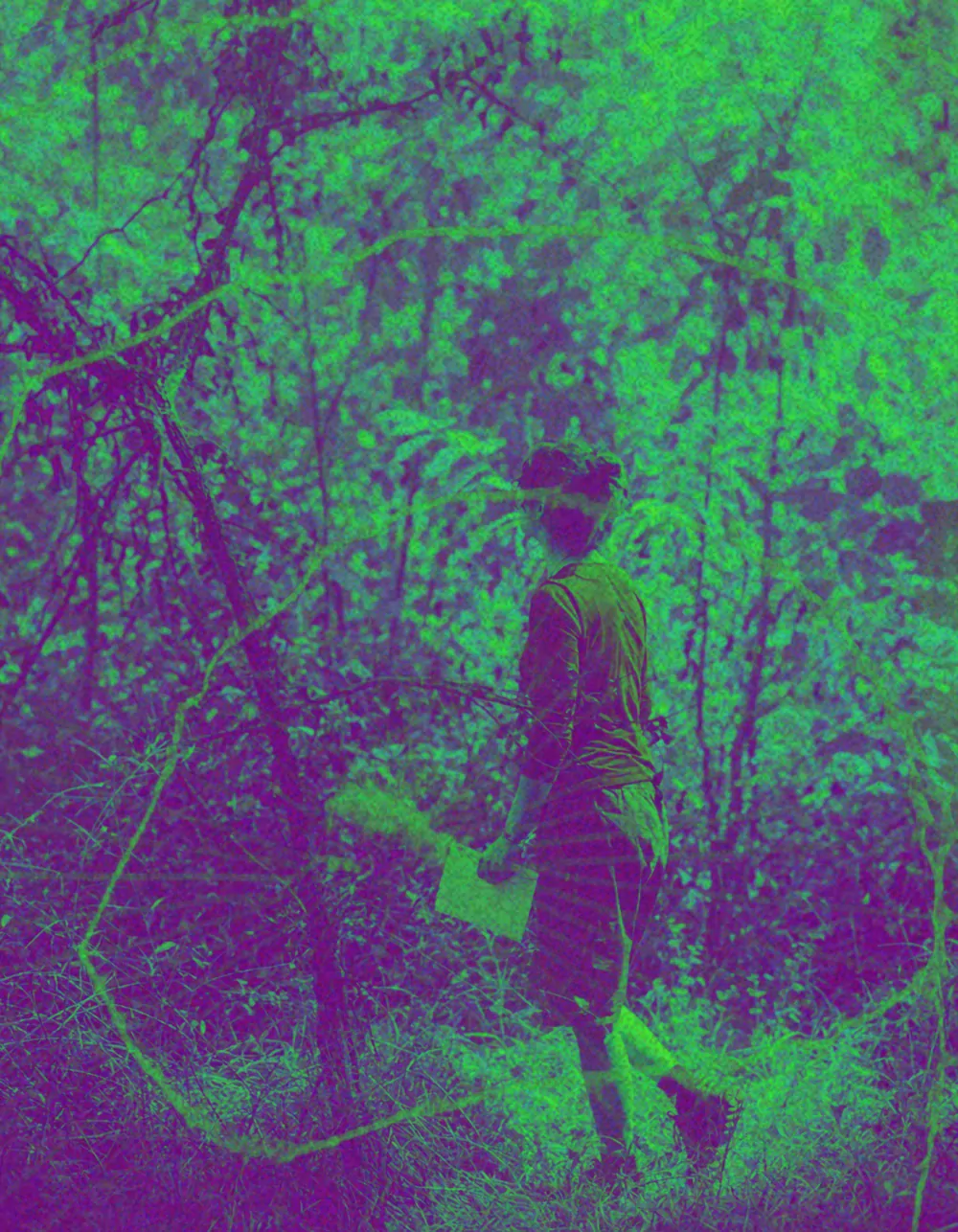
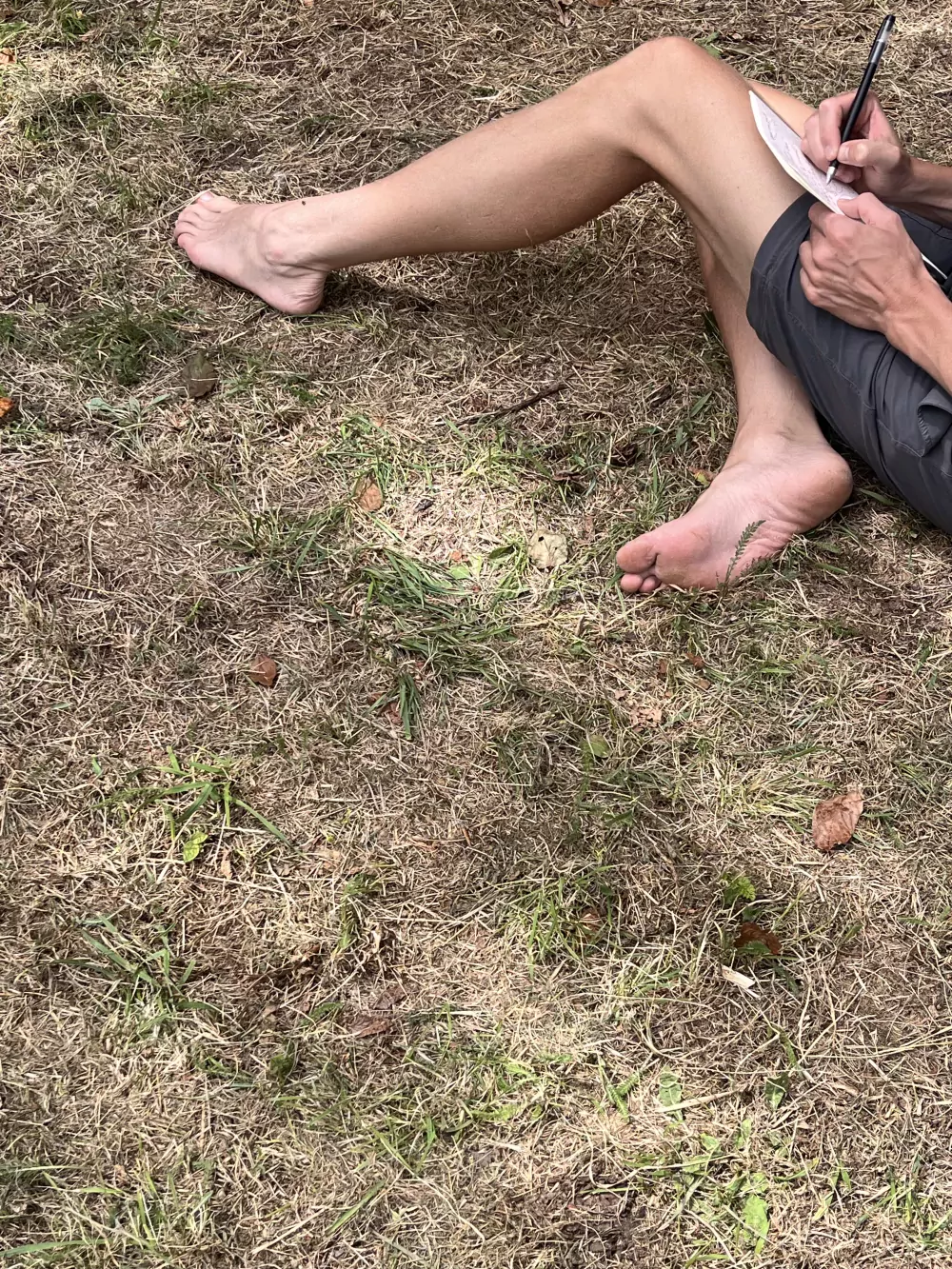
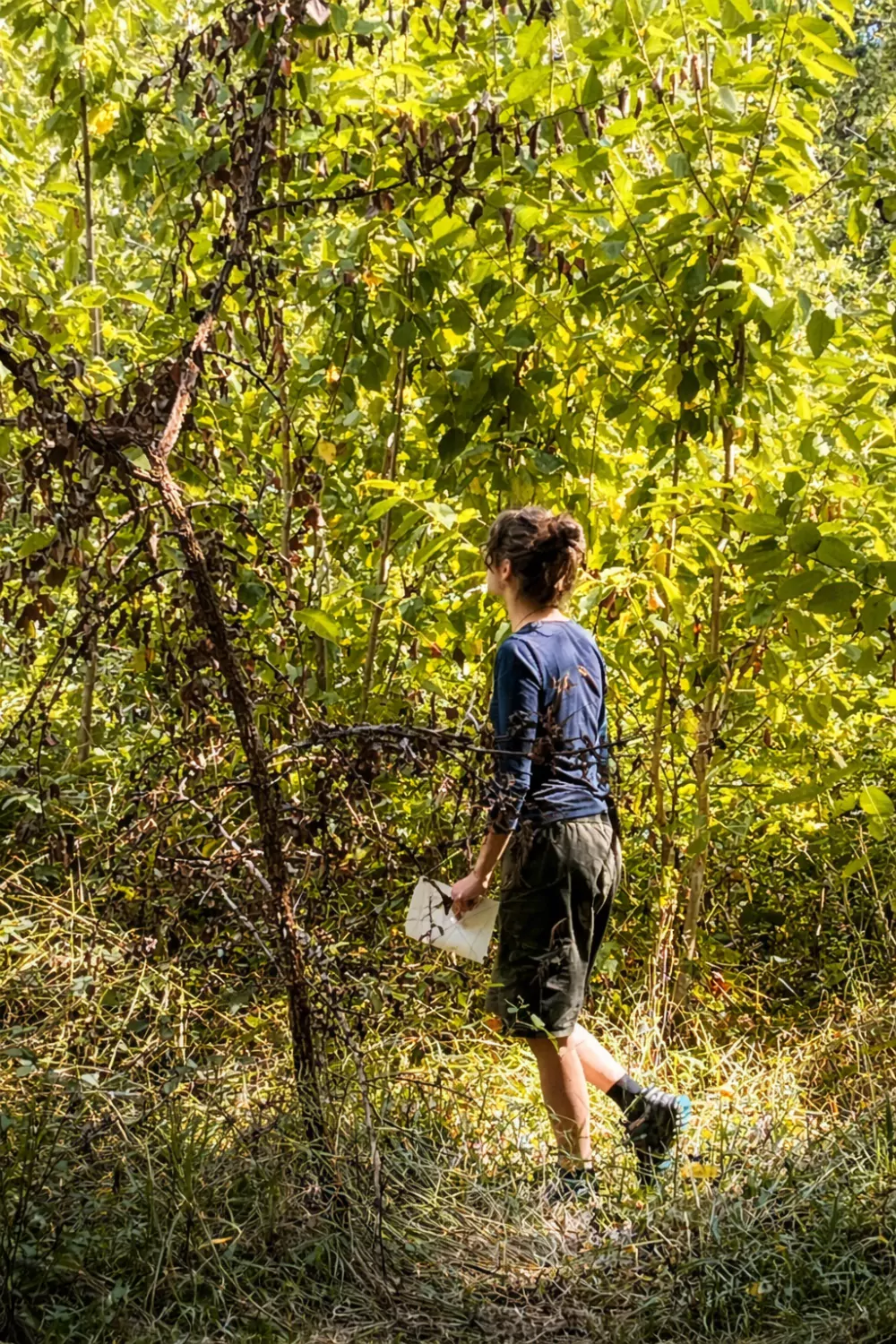
2. From this slowed and attuned state, participants are handed a workshop booklet (see WWBooklet template below) and asked to choose a place, element, object, or presence within the a particular site that catches their attention - and to dwell with it without immediately naming or defining it. The booklet offers prompts for noticing, translating, and playing with what emerged in the encounter: traces could take the form of marks, words, gestures, drawings, or even absences.
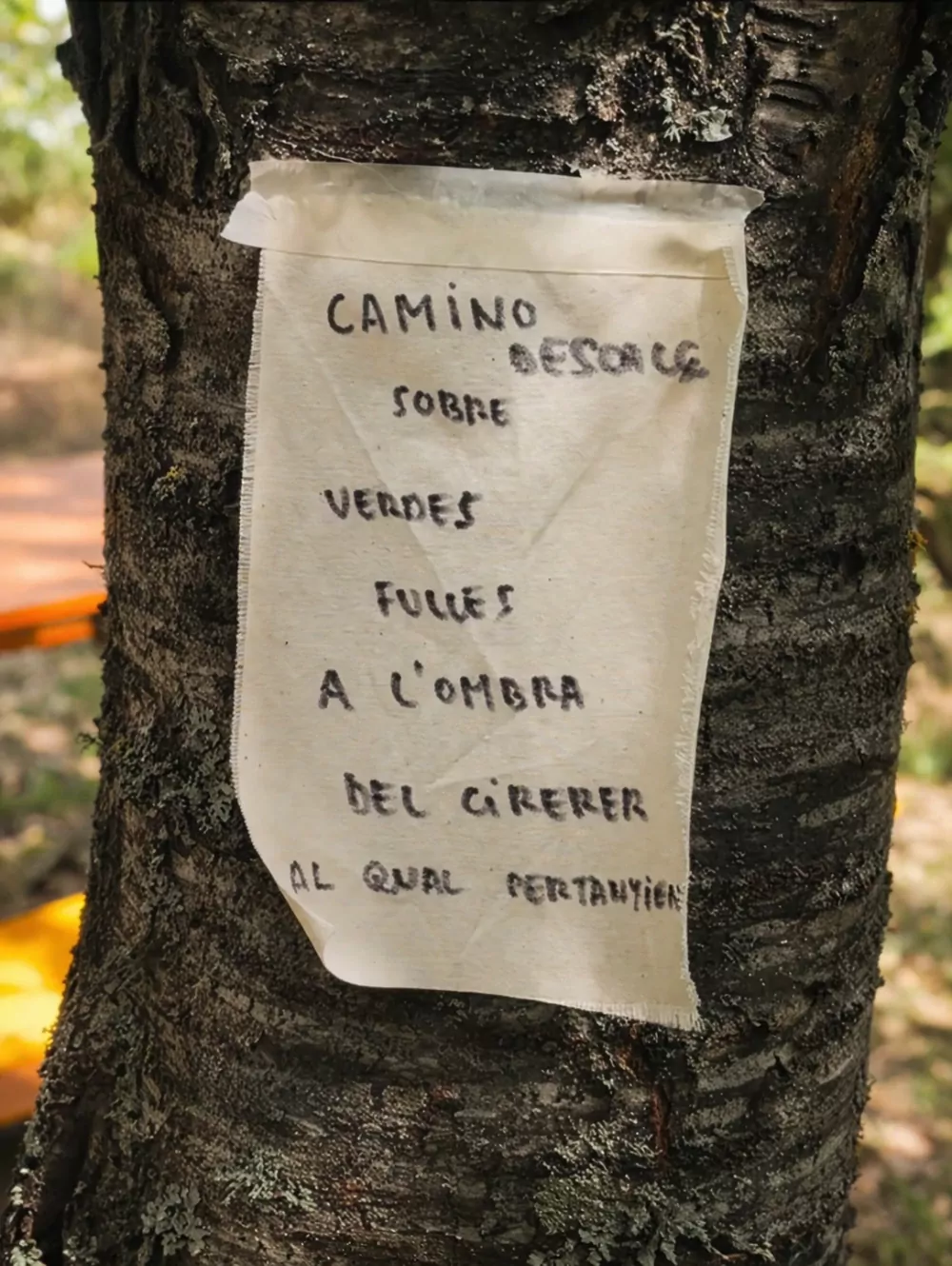
3. In the final creative writing phase, participants are invited to jot down all of their thoughts in regards to the experience on the last page of the booklet, then highlight specific words and transfer them onto a shared canvas using coloured acrylic pencils - producing a collective, temporary installation that could crystallise the overall experience: a mycelial collective subjectivity, hanging within the space of the particular site.
Engagement with more-than-human entities
In this practice, soil, wind, trees, insects, sound, light, texture, water, are not backdrop but as active co-participants in the encounter. The silent walk instruction (borrowed from Oliveros’s work) reframes the feet as sensory organs attuned to the ground. The booklet prompts encourages participants to attend to presences that usually escape notice: a patch of moss, the sound of wind in different textures, the weight of a shadow. Rather than naming or categorising what is found, participants are invited to remain with it, allowing the more-than-human to act upon their perception. The resulting installation made of poems and marks hung in the open air, became a site where human expression and environmental agency intertwined, materially and affectively. The workshop treats a particular site as a living network, and participants as nodes within it, temporarily attuning to entanglements that usually remain invisible.
Interpretation as “retracing”
Wandering Wonders – Encounters at the Margins contributes to retracing in several interconnected ways.
1. It models observation as encounter rather than extraction. Conventional data collection often positions the researcher as a neutral witness gathering information from a field. This workshop instead proposes that attending to the world, including its more-than-human dimensions, requires a bodily, affective disposition: one that begins with slowing down, unlearning habitual perception, and opening oneself to being acted upon by what one notices within a liminal threshold. This offers a methodological resource for researchers seeking to develop more reciprocal and situated modes of inquiry.
2. The workshop makes affect and embodied knowledge legible as data. The booklet-as-probe functions as a trace-making device: it does not ask participants to explain or analyse, but to notice, feel, and play; generating materials (marks, words, rhythms, drawings) that hold something of the relational encounter. This expands what counts as evidence or material in participatory design and ethnographic research, particularly for capturing the invisible, affective dimensions of collective experience.
3. The practice demonstrates how language can be queered and reconfigured as a representational medium. Participants were observed treating the booklet not as a transcription tool but as a performative object: some produced rhythmic marks instead of words, others drew before writing, others crossed out and rewrote. This destabilises the assumption that knowledge must always pass through linguistic categorisation, and suggests that for researchers working in liminal or embodied contexts, non-linguistic traces may carry information that words would flatten.
4. The temporary installation produced by the workshop enacts what retracing calls for: making interdependencies visible. The collective canvas, assembled from individual encounters with specific places, sounds, textures, and presences, became a material record of the entanglements between human participants, the festival site, and its more-than-human inhabitants. It materialised, however briefly, the invisible threads that held the festival's (or whatever other site) living mycelium together.
Case study
One participant's formulation captures a shift in perception very well: rather than writing about "encountering" something, they changed their phrasing to "welcoming" it; a subtle but significant reorientation, from observation-as-extraction to observation-as-hospitality.
Other participants reactions:
“We are so locked into perceiving the world just one way that we forget how to feel”
“Down this sky we all breathe the same air and feel the sound of this wind in different textures, with different minds. Being here but around.”
“Sometimes we linger too much on finding the best words and their combinations, but in reality, they don't exist; what does exist is the process that led you to them.”
Is there a tool?
The workshop booklet (Wandering Wonders – Encounters at the Margins, FDCB 2025) functions as an adaptable probe. It is designed by Andy Peruccon and structured around prompts for noticing, translating, and playing with what emerges in an encounter. It is currently in use as part of Andy's doctoral research at Malmö University and is developed to be an open-access tool for design research.
References
Barad, K. (2003). Posthumanist Performativity: Toward an Understanding of How Matter Comes to Matter. Signs: Journal of Women in Culture and Society, 28(3), 801–831. https://doi.org/10.1086/345321
Federici, S. (with Linebaugh, P.). (2019). Re-enchanting the world: Feminism and the politics of the commons. PM Press.
Ingold, T. (2013). Making: Anthropology, archaeology, art and architecture. Routledge.
Oliveros, P., & Bourne, A. (2022). Sonic meditations. PoPandMoM Publications.
Stiegler, B. (2014). The Re-Enchantment of the World: The value of spirit against industrial populism. Bloomsbury Academic. https://doi.org/10.5040/9781472545947
Links